Premier Obstetrics and Gynaecology Care
at Fortis Hospital Vasant Kunj





Fortis Hospital, Vasant Kunj is your trusted partner for comprehensive Obstetrics and Gynaecology care in Delhi NCR. With a team of leading specialists and state-of-the-art facilities, we are dedicated to providing the highest quality care for women at every stage of life, from adolescence to menopause and beyond.
Comprehensive Women’s Wellness: Beyond medical care, we offer holistic services including nutrition counseling, prenatal yoga, and mental health support, ensuring complete wellness during pregnancy and throughout a woman’s life.










Two High-Risk Patients Recover After Rare Combined Cardiac and Liver Transplant Procedures at Fortis Hospital, Shalimar Bagh
Fortis Hospital, Shalimar Bagh, achieved a significant medical milestone by successfully treating two critically ill patients suffering from advanced liver failure alongside severe cardiac conditions through a series of highly complex, multidisciplinary procedures.
The first patient, a 46-year-old man from Uzbekistan, was diagnosed with decompensated chronic liver disease and severe triple-vessel coronary artery disease involving blockages in all three major heart arteries. Given the high surgical risk, the team performed a beating-heart coronary artery bypass graft (CABG) surgery to minimise bleeding complications, immediately followed by a living-donor liver transplant during the same operative session.
The second patient, aged 41 years, was suffering from advanced liver disease along with critical aortic valve stenosis, a condition that severely restricted blood flow from the heart. The multidisciplinary team first performed open-heart valve replacement surgery and, after closely monitoring the patient for 24 hours to ensure stability, successfully carried out a living-donor liver transplant the following day.
Both patients had decompensated chronic liver disease, a life-threatening condition associated with complications such as jaundice, fluid accumulation, bleeding tendencies, and kidney dysfunction. Liver transplantation represented their only definitive treatment option; however, their underlying cardiac conditions significantly increased the complexity and risk of surgery.
Led by Dr. Ashish George and supported by a multidisciplinary team of liver transplant surgeons, cardiologists, cardiac surgeons, anaesthetists, intensivists, and transplant specialists, the procedures required meticulous planning, seamless coordination, and advanced perioperative care.
Both patients recovered steadily following surgery and were discharged within three weeks with stable cardiac function and well-functioning transplanted livers.
This rare achievement highlights Fortis Hospital, Shalimar Bagh’s expertise in managing some of the most complex medical and surgical cases, demonstrating the power of multidisciplinary collaboration, advanced surgical capabilities, and patient-centred care in delivering life-saving outcomes.

 10 Years
 2000
2000


4.6


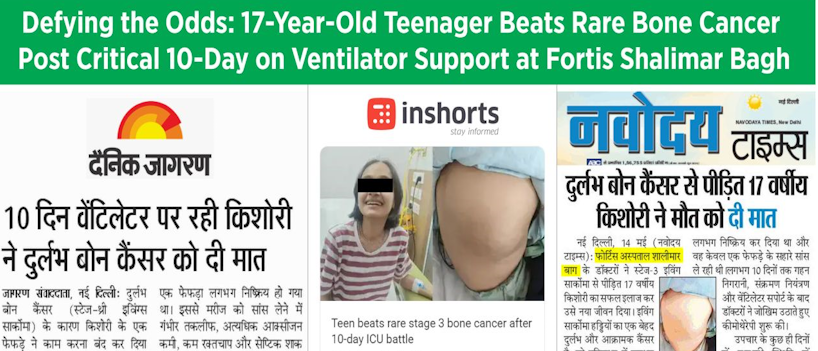
17-Year-Old with Advanced Ewing’s Sarcoma Successfully Recovers Following Complex Oncology and Critical Care Management
Fortis Hospital, Shalimar Bagh successfully managed a highly complex and challenging case involving a 17-year-old girl diagnosed with Stage 3 Ewing’s Sarcoma, a rare and aggressive form of bone cancer, who presented with severe complications requiring advanced oncology and critical care intervention.
The patient’s condition was further complicated by significant respiratory distress, septic shock, and prolonged dependence on ventilatory support, making her treatment journey particularly challenging. The case was led by Dr. Suhail Qureshi, who worked closely with a multidisciplinary team comprising oncology, critical care, respiratory medicine, nursing, and support specialists to develop and execute a comprehensive treatment strategy.
Despite the critical nature of her illness, the team successfully stabilised the patient through intensive critical care management while simultaneously administering carefully monitored chemotherapy. Through continuous monitoring, coordinated decision-making, and personalised treatment planning, the patient demonstrated significant clinical improvement and was eventually weaned off ventilatory support.
The successful outcome highlights the importance of a multidisciplinary approach in managing rare and advanced cancers, particularly when accompanied by life-threatening complications. It also underscores the expertise, clinical excellence, and collaborative care model that form the foundation of patient management at Fortis Hospital, Shalimar Bagh.
Commenting on the achievement, Mr. Naveen Sharma emphasised the role of teamwork and integrated healthcare delivery in achieving positive outcomes in complex medical cases and reaffirmed the hospital’s commitment to providing advanced, patient-centric care.
This breakthrough case stands as a testament to the dedication of the hospital’s oncology and critical care teams and reflects Fortis Hospital, Shalimar Bagh’s continued pursuit of excellence in treating complex and high-risk medical conditions.
 11 Years
1200
11 Years
1200
4.6
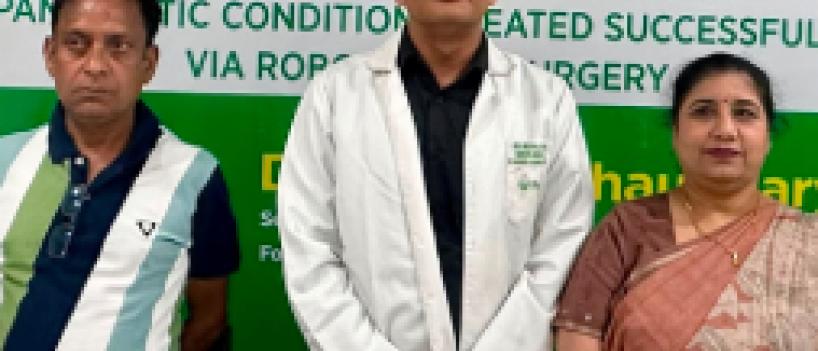
Walled off Pancreatic Necrosis is a rare complication of acute pancreatitis affecting nearly 1 - 9% of people globally
New Delhi, 5th June 2026: Doctors at Fortis Hospital Vasant Kunj successfully performed a highly complex robotic pancreatic necrosectomy on a 51-year-old man suffering from Walled-Off Pancreatic Necrosis (WOPN), a rare and potentially life-threatening complication of acute pancreatitis. The team of doctors led by Dr. Neeraj Chaudhary, Senior Director & Head, GI Surgery, GI Oncology & Robotics, Fortis Hospital Vasant Kunj adopted an advanced minimally invasive robotic procedure to help the patient recover well, significantly reducing the risks of major complications associated with conventional open surgery.
Patient Naveen Kumar Jain was admitted at Fortis Vasant Kunj with recurrent abdominal pain and persistent fever that had continued for nearly two months. He was unable to tolerate solid food and had suffered significant weight loss during this period. Initially, he was 69 kgs, but due to the pancreatic condition, he lost a significant 12kgs. A known diabetic, the patient had also undergone multiple hospital admissions in Sonipat for severe abdominal pain requiring intravenous pain management.
Detailed investigations, including a contrast-enhanced CT scan of the abdomen, revealed a large 6 cm × 6 cm collection of Walled-Off Pancreatic Necrosis, a condition in which dead pancreatic tissue becomes encapsulated and infected following severe pancreatitis. If left untreated, the condition can result in severe infection, internal bleeding, malnutrition, organ dysfunction, and other life-threatening complications.
Following a comprehensive evaluation, the multidisciplinary team decided to proceed with a robotic pancreatic necrosectomy along with drainage of the infected collection. During surgery, the doctors encountered extensive inflammation and dense scar tissue surrounding the pancreas.
Nearly 450 ml of infected fluid and pus was successfully drained, and the diseased tissue was carefully removed. The robotic platform enabled superior visualisation and precision while operating around major blood vessels and other critical structures. The five-hour procedure was completed successfully, and the patient showed steady improvement post-operatively. He was discharged in a stable condition just five days after the procedure
Giving details of the case, Dr. Neeraj Chaudhary, Senior Director & Head, GI Surgery, GI Oncology & Robotics , Fortis Hospital Vasant Kunj, said, “Walled-Off Pancreatic Necrosis is among the most complex complications of pancreatitis and can become life-threatening if not managed at the right time. Surgery in these cases can be complex because scar tissue and anatomical changes make it difficult to access the affected area safely, increasing the risk of complications. Robotic surgery offers superior visualization, enhanced dexterity, and greater precision, allowing us to safely access and clear the infected pancreatic cavity while minimizing trauma to surrounding tissues. Compared to conventional open surgery, robotic pancreatic necrosectomy is associated with lower morbidity, shorter ICU and hospital stays and faster recovery. In this case, timely intervention prevented potentially devastating complications and enabled the patient to return to normal life.”
“WOPN remains one of the most challenging pancreatic conditions to treat surgically due to severe inflammation and distorted anatomy associated with the disease. If left untreated, the condition can lead to rupture of the pancreatic collection, life-threatening internal bleeding, severe malnutrition, brittle diabetes and a significant deterioration in quality of life,” he added.
Dr. Gurvinder Kaur, Facility Director, Fortis Hospital, Vasant Kunj said, “The successful management of this highly complex case highlights Fortis Hospital Vasant Kunj’s advanced expertise in robotic gastrointestinal and pancreatic surgery. It reinforces our commitment to delivering cutting-edge, patient-centric care and providing access to the latest surgical innovations for patients with complex and high-risk conditions.”
 20 Years 15
1500
20 Years 15
1500

4.5
