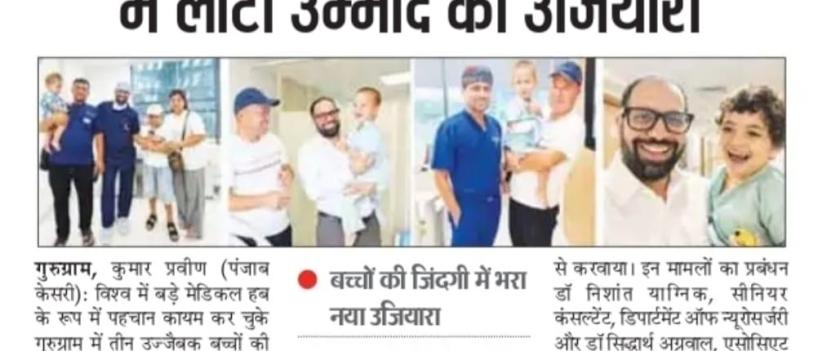


Fortis Hospital Manesar Treats Three Uzbek Children with Drug-Resistant Epilepsy
Treated by:
Dr. Nishant Yagnick
Neuro and Spine Surgery
| Fortis Hospital Manesar, Gurugram
Oct 23, 2026
Fortis Hospital Manesar, Gurugram, has successfully treated three children from Uzbekistan suffering from drug-resistant epilepsy. Despite taking multiple anti-seizure medications, the children continued to experience recurrent seizures, requiring detailed neurological evaluation and specialised treatment.
Following comprehensive assessments, the neurosurgery team developed individualised treatment plans based on each child's condition. Two children underwent Vagus Nerve Stimulation (VNS) implantation, while the third underwent a specialised microsurgical brain procedure.
The treatment was led by Dr. Nishant Yagnick, Senior Consultant, and Dr. Sidharth Agarwal, Associate Consultant, Department of Neurosurgery, Fortis Hospital Manesar.
Early follow-up assessments showed encouraging improvements in seizure control. One child had no seizures reported after the intervention, while another experienced a reduction in seizure frequency. The third child also showed improvement in seizure control, speech and hand movement.
This clinical achievement highlights the role of advanced neurosurgery and personalised epilepsy treatment for selected children whose seizures remain uncontrolled despite medication.
Dr. Nishant Yagnick, Senior Consultant, Department of Neurosurgery, Fortis Hospital Manesar, said:
“In these cases, we used nerve stimulation and specialised microscopic brain surgery based on each child's medical needs. The early outcomes have been encouraging, with better seizure control and reduced medication requirements. We aim to help children achieve sustained seizure control, ideally with minimal or no medication, wherever clinically appropriate. Timely medical intervention and the correct line of treatment can make a meaningful difference to their quality of life.”
Meet the doctor

Dr. Nishant Yagnick
Senior Consultant Neuro Surgery | Fortis Manesar
- Neurosurgery | Neuro and Spine Surgery
-
 14 Years
-
 1200
Treated at Hospital

Fortis Hospital Manesar, Gurugram
4.5

4.5


Read more about
Neuro and Spine Surgery
35 Doctor available at
22 locations
Understanding Urological Cancers, Diagnosis and Treatment
Uro-Oncology treatment at Fortis Hiranandani Hospital, Vashi
Uro-oncology is a specialized field of urology concerned with cancers affecting the urinary system and male reproductive organs. These include prostate, kidney and bladder cancers as well as selected cancers of the ureter and testis.
Understanding the condition, available diagnostic investigations and possible treatment approaches can help patients and families prepare for discussions with their treating doctor.
Symptoms That May Need Medical Evaluation
Some urological cancers cause few or no symptoms in their early stages. When symptoms occur, they may include:
- Blood in the urine
- Persistent changes in urinary frequency or flow
- Difficulty passing urine
- A lump or swelling in a testicle
- Persistent discomfort in the side or back without an established explanation
- An abnormal finding on imaging or other investigations
These symptoms can have causes other than cancer. Their presence does not confirm a cancer diagnosis.
Blood in the urine should be medically assessed even if there is no pain or the bleeding stops. Sudden inability to pass urine requires urgent medical attention.
How Are Urological Cancers Diagnosed?
The diagnostic process depends on the suspected cancer and the patient's medical history. Investigations may include:
1. Clinical assessment - The doctor reviews symptoms, medical history, examination findings and relevant risk factors.
2. Laboratory investigations - Blood and urine tests may help assess the condition and guide further evaluation.
3. Imaging - Ultrasound, CT or MRI may be recommended depending on the suspected cancer and clinical findings.
4. Endoscopic evaluation or biopsy - Procedures such as cystoscopy or tissue biopsy may be required to examine abnormalities and establish a diagnosis.
5. Assessment of disease extent - When cancer is confirmed, further investigations may be needed to determine its stage and guide treatment planning.
Not every patient requires all investigations. The treating doctor determines which tests are appropriate.
Understanding Treatment Options
Treatment is based on the cancer type, stage, tumour characteristics, the patient's general health and personal circumstances.
Depending on the diagnosis, options may include:
1. Active Surveillance - For selected cancers with a low risk of progression, monitoring may be appropriate instead of immediate treatment. This requires a structured follow-up plan.
2. Surgery - Surgery may be recommended to remove a tumour or affected tissue when clinically indicated. The type of procedure depends on the location and extent of the disease.
3. Minimally Invasive and Robotic-Assisted Surgery -
For selected patients, minimally invasive procedures may be considered. Robotic assistance may be appropriate for certain operations depending on the clinical indication, surgeon's assessment and availability of the service.
4. Other Cancer Treatments - Depending on the cancer, treatment may involve medicines, radiation therapy or other specialist-led approaches. Some patients may require coordination between urology, medical oncology, radiation oncology and other specialties.
No single treatment is suitable for every patient. The benefits, risks and alternatives should be discussed with the treating team.
What Is the Role of a Uro-Oncology Specialist?
A uro-oncology specialist evaluates suspected or confirmed cancers affecting the urinary system and male reproductive organs. The specialist may help patients understand their investigation findings, determine whether further tests are needed, discuss suitable treatment options and plan follow-up care.
Patients who already have a diagnosis may bring their previous reports and treatment records for review.
Uro-oncology Services at Fortis Hiranandani Hospital, Vashi
Fortis Hiranandani Hospital, Vashi, provides urology services for the assessment and management of uro-oncology conditions.
For information about the hospital's uro-oncology services, relevant diagnostic facilities and available treatment procedures, contact the hospital through its official communication channels.
What Conditions Does Uro-Oncology Cover?
Our Team of Experts
Understanding Urological Cancers, Diagnosis and Treatment
Fortis Specialist Uro-oncology Treatment at Mangal Anand Hospital, Chembur
Uro-oncology is a specialized field of urology concerned with cancers affecting the urinary system and male reproductive organs. These include prostate, kidney and bladder cancers as well as selected cancers of the ureter and testis.
Understanding the condition, available diagnostic investigations and possible treatment approaches can help patients and families prepare for discussions with their treating doctor.
Symptoms That May Need Medical Evaluation
Some urological cancers cause few or no symptoms in their early stages. When symptoms occur, they may include:
- Blood in the urine
- Persistent changes in urinary frequency or flow
- Difficulty passing urine
- A lump or swelling in a testicle
- Persistent discomfort in the side or back without an established explanation
- An abnormal finding on imaging or other investigations
These symptoms can have causes other than cancer. Their presence does not confirm a cancer diagnosis.
Blood in the urine should be medically assessed even if there is no pain or the bleeding stops. Sudden inability to pass urine requires urgent medical attention.
How Are Urological Cancers Diagnosed?
The diagnostic process depends on the suspected cancer and the patient's medical history. Investigations may include:
1. Clinical assessment - The doctor reviews symptoms, medical history, examination findings and relevant risk factors.
2. Laboratory investigations - Blood and urine tests may help assess the condition and guide further evaluation.
3. Imaging - Ultrasound, CT or MRI may be recommended depending on the suspected cancer and clinical findings.
4. Endoscopic evaluation or biopsy - Procedures such as cystoscopy or tissue biopsy may be required to examine abnormalities and establish a diagnosis.
5. Assessment of disease extent - When cancer is confirmed, further investigations may be needed to determine its stage and guide treatment planning.
Not every patient requires all investigations. The treating doctor determines which tests are appropriate.
Understanding Treatment Options
Treatment is based on the cancer type, stage, tumour characteristics, the patient's general health and personal circumstances.
Depending on the diagnosis, options may include:
1. Active Surveillance - For selected cancers with a low risk of progression, monitoring may be appropriate instead of immediate treatment. This requires a structured follow-up plan.
2. Surgery - Surgery may be recommended to remove a tumour or affected tissue when clinically indicated. The type of procedure depends on the location and extent of the disease.
3. Minimally Invasive and Robotic-Assisted Surgery - For selected patients, minimally invasive procedures may be considered. Robotic assistance may be appropriate for certain operations depending on the clinical indication, surgeon's assessment and availability of the service.
4. Other Cancer Treatments - Depending on the cancer, treatment may involve medicines, radiation therapy or other specialist-led approaches. Some patients may require coordination between urology, medical oncology, radiation oncology and other specialties.
No single treatment is suitable for every patient. The benefits, risks and alternatives should be discussed with the treating team.
What Is the Role of a Uro-Oncology Specialist?
A uro-oncology specialist evaluates suspected or confirmed cancers affecting the urinary system and male reproductive organs. The specialist may help patients understand their investigation findings, determine whether further tests are needed, discuss suitable treatment options and plan follow-up care.
Patients who already have a diagnosis may bring their previous reports and treatment records for review.
Fortis Specialist Uro-oncology Services at Mangal Anand Hospital, Chembur
Mangal Anand Hospital, Chembur provides uro-oncology services for the assessment and management of uro-oncology conditions.
For information about the hospital's uro-oncology services, relevant diagnostic facilities and available treatment procedures, contact the hospital through its official communication channels.
What Conditions Does Uro-Oncology Cover?
Our Team of Experts
Expert Kidney Transplant Care for a Better Tomorrow
A kidney transplant can offer eligible patients with end-stage kidney disease an opportunity to improve their quality of life and reduce their dependence on dialysis.
At Fortis Hospital, Gurugram, India, patients can access specialised nephrology care, comprehensive transplant evaluation, and coordinated medical support throughout the kidney transplant journey. Our multidisciplinary team focuses on individualised treatment planning, patient education, and long-term follow-up care.
Kidney transplantation is a surgical procedure in which a healthy kidney from a suitable donor is placed in a recipient whose kidneys are no longer functioning adequately.
At Fortis Hospital, Gurugram, the kidney transplant care pathway may include:
- Comprehensive kidney function assessment
- Evaluation for kidney transplant suitability
- Donor and recipient compatibility assessment
- Living-donor transplant evaluation, where appropriate
- Pre-transplant counselling and preparation
- Post-transplant monitoring and follow-up
- Guidance on immunosuppressive medicines and long-term kidney health
Treatment recommendations are individualised according to each patient's medical condition, transplant eligibility, and clinical requirements.
When Should You Consider a Kidney Transplant?
A kidney transplant evaluation may be appropriate for patients experiencing:
- Advanced chronic kidney disease
- End-stage kidney disease
- Long-term dependence on dialysis
- Progressive loss of kidney function
- Kidney failure associated with conditions such as diabetes or high blood pressure
Your Kidney Transplant Journey
1. Initial Consultation
Discuss your medical history, kidney function, dialysis status, and treatment goals with the specialist.
2. Transplant Evaluation
Undergo the investigations required to assess your suitability for transplantation.
3. Donor Compatibility Assessment
Where applicable, the transplant team evaluates donor suitability and compatibility in accordance with clinical and regulatory requirements.
4. Transplant Procedure and Hospital Care
If transplantation is recommended and approved, the medical team plans the procedure and provides perioperative care.
5. Recovery and Long-Term Follow-Up
Regular monitoring, prescribed medication, and follow-up appointments help support the health of the transplanted kidney.
Frequently Asked Questions
What is a kidney transplant?
A kidney transplant is a surgical procedure that places a healthy donor kidney into a person with kidney failure. Suitability depends on a comprehensive medical evaluation.
Is a kidney transplant better than dialysis?
For eligible patients, transplantation may offer better quality of life and clinical outcomes than long-term dialysis. However, the benefits and risks vary between individuals, and transplantation is not suitable for everyone.
Can a kidney transplant be performed using a living donor?
Yes. Living-donor transplantation may be possible when the donor meets medical and legal requirements and the necessary compatibility assessments are completed.
How can I book a kidney transplant consultation at Fortis Hospital, Gurugram?
Contact Fortis Hospital, Gurugram, to schedule a consultation with the nephrology team and discuss your medical reports, dialysis history, and possible treatment options.
Take the Next Step Towards Better Kidney Care
If you or a loved one has advanced kidney disease, an expert opinion can help you understand the available treatment options.