


ABO Incompatible Kidney Transplantation - Breaking Barriers in Organ Transplantation
INTRODUCTION
Pioneering ABO Incompatible Transplants in the Region
For decades, blood group compatibility was considered an absolute requirement for kidney transplantation. If a donor's blood type didn't match the recipient's, the transplant was deemed impossible. This rigid barrier meant that countless patients with willing family donors were forced to wait indefinitely on transplant lists, watching their kidney function deteriorate while a perfectly healthy kidney from a loved one couldn't be used.
Fortis Hospital Mohali changed this narrative.
As the first center in the region to introduce ABO incompatible kidney transplantation, we have successfully performed over 200 ABO incompatible transplants, transforming impossible situations into life-saving opportunities. This groundbreaking achievement has made Fortis Mohali a regional leader in advanced transplant medicine, offering hope to patients who previously had none.
UNDERSTANDING ABO INCOMPATIBLE KIDNEY TRANSPLANTATION
What Is ABO Incompatible Transplant?
An ABO incompatible kidney transplant involves transplanting a kidney from a donor whose blood group is different from and incompatible with that of the recipient.
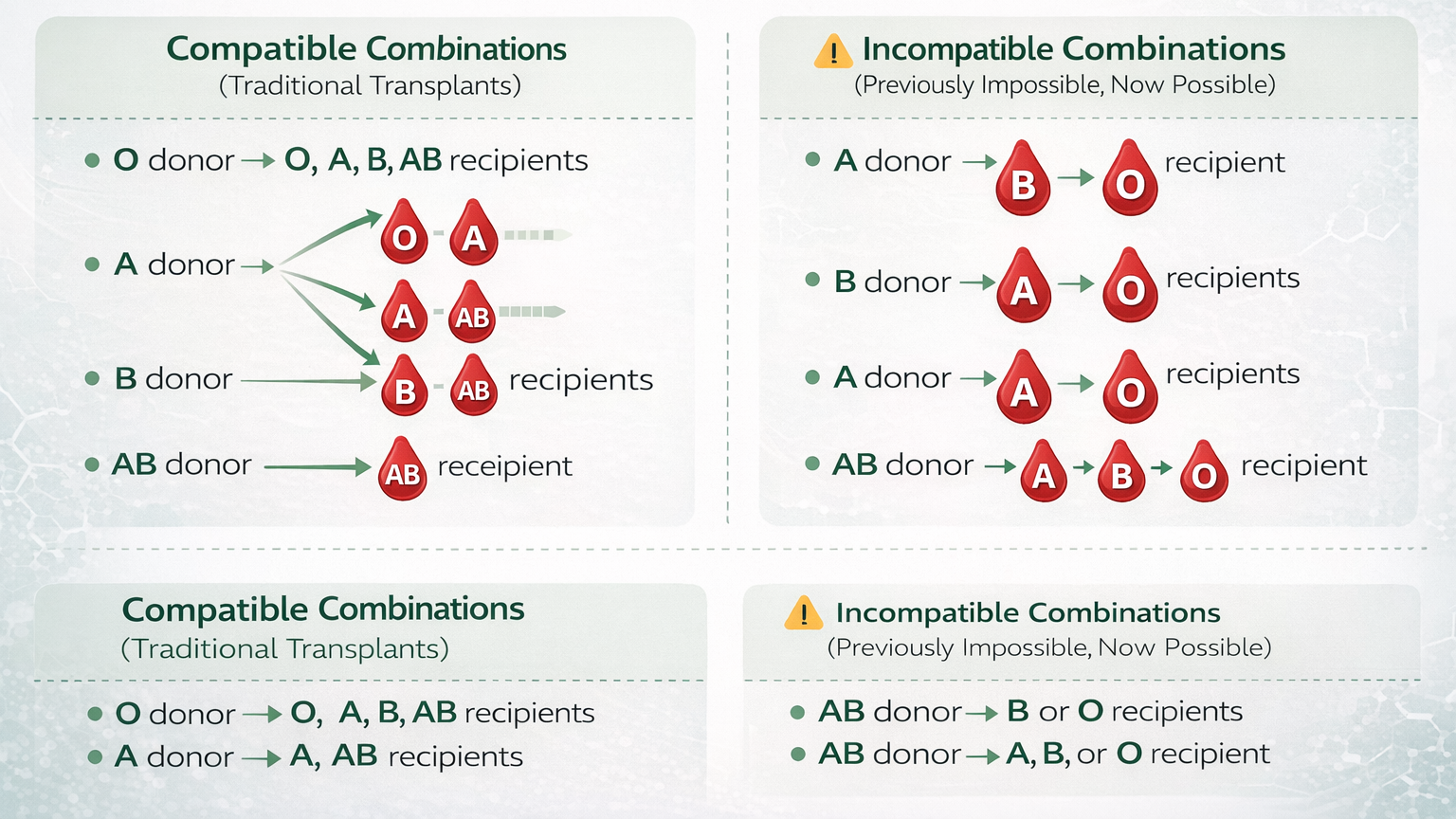
Blood Group Compatibility Basics:
The Scientific Breakthrough
Human blood contains natural antibodies against blood group antigens that differ from one's own blood type. For example, a person with blood group A has anti-B antibodies, and a person with blood group O has both anti-A and anti-B antibodies. These antibodies would normally attack and destroy an incompatible transplanted kidney within minutes to hours, a process called hyperacute rejection.
Modern medical science has developed sophisticated techniques to safely remove or suppress these antibodies, allowing incompatible transplants to succeed with outcomes comparable to compatible transplants.
WHY ABO INCOMPATIBLE TRANSPLANTS ARE PERFORMED
Addressing the Organ Shortage Crisis
India faces a severe shortage of organ donors. According to national data:
- Over 200,000 patients need kidney transplants annually
- Only 7,000-8,000 transplants are performed each year
- Average waiting time on dialysis: 3-5 years
- Many patients die waiting for a compatible donor
The Life-Changing Impact
ABO incompatible transplantation expands the donor pool by approximately 30-35%, meaning:
Before ABO Incompatible Programs:
- A patient with blood group B could only receive from B or O donors
- Family members with A or AB blood group couldn't donate
- Patients remained on dialysis indefinitely
After ABO Incompatible Programs:
- Same patient can now receive from A, B, AB, or O donors
- Previously "incompatible" family members can donate
- Patients get off dialysis months or years earlier
Real-World Scenarios
Case 1: The Desperate Wait A 42-year-old man with blood group O in kidney failure. His wife (blood group A) is willing to donate, but is incompatible. Without ABO incompatible transplant capability, he would wait 5+ years for a compatible deceased donor while his health deteriorates on dialysis.
Case 2: The Perfect Match That Wasn't A 35-year-old woman with blood group A needs a transplant. Her father (blood group B) is healthy and eager to donate, but blood groups don't match. ABO incompatible transplant makes this life-saving donation possible.
HOW ABO INCOMPATIBLE TRANSPLANTS ARE PERFORMED
The Complete Process
Phase 1: Pre-Transplant Preparation (2-4 Weeks)
Step 1: Comprehensive Evaluation
- Antibody level testing (ABO antibody titers)
- Complete donor and recipient workup
- Cross-matching and tissue typing
- Medical optimization
Step 2: Desensitization Protocol The goal is to reduce anti-blood group antibodies to safe levels before transplant.
Medications:
- Rituximab: Reduces antibody-producing B cells (given 2-4 weeks before transplant)
- Immunosuppressants: Tacrolimus, Mycophenolate to suppress immune system
- Intravenous Immunoglobulin (IVIG): Neutralizes antibodies
Plasmapheresis (Plasma Exchange): This is the cornerstone technique that makes ABO incompatible transplants possible.
What is Plasmapheresis?
- A specialized blood filtration procedure
- Blood is removed from the patient through a vein
- A machine separates plasma (containing antibodies) from blood cells
- The antibody-containing plasma is discarded
- Blood cells are returned with replacement fluid (albumin or fresh frozen plasma)
- Each session takes 2-3 hours
- Typically 3-6 sessions needed pre-transplant, as per the antibody titre levels.
How It Works: Think of your blood as a river carrying both essential nutrients (blood cells) and unwanted debris (anti-blood group antibodies). Plasmapheresis acts like a sophisticated filtration system that removes the debris while preserving everything essential, allowing an incompatible kidney to be safely accepted.
Phase 2: The Transplant Surgery
Once antibody levels are reduced to safe thresholds (typically antibody titer ≤1:16), the transplant proceeds exactly like a standard kidney transplant:
- Duration: 3-4 hours
- Technique: Robotic or open surgery (we perform robotic kidney transplants)
- The incompatible kidney is transplanted into the recipient's pelvis
- Blood vessels and ureter are connected
- The kidney begins functioning immediately or within days
Phase 3: Post-Transplant Monitoring (Critical 4 Weeks)
Close Monitoring Protocol:
- Daily antibody level checks for first 2 weeks
- Twice weekly for weeks 3-4
- Kidney function tests (creatinine), urine output
- Immunosuppression drug levels
- Ultrasound monitoring for rejection signs
Additional Plasmapheresis If Needed: If antibody levels rise dangerously (rebound), plasmapheresis can be repeated to bring them down. This is usually only needed in the first 2-3 weeks.
The Accommodation Phenomenon: After 3-4 weeks post-transplant, something remarkable happens called accommodation. Even if antibody levels rise again, they no longer harm the transplanted kidney. The kidney has adapted to coexist with the antibodies, providing long-term protection. This is one of nature's most fascinating immune tolerance mechanisms.
SAFETY AND SUCCESS RATES
How Safe Are ABO Incompatible Transplants?
With modern protocols and experienced teams, ABO incompatible transplants are remarkably safe.
International Data:
- 1-year graft survival: 95-98% (comparable to compatible transplants)
- 5-year graft survival: 85-90%
- Patient survival: >95% at 5 years
- Rejection rates: 10-15% in first year (slightly higher than blood group compatible transplants, but manageable)
Fortis Mohali Experience: With over 200 successful ABO incompatible transplants, our outcomes match international benchmarks, demonstrating the safety and efficacy of this procedure when performed by experienced teams.

Key Takeaway: While ABO incompatible transplants require more intensive preparation and monitoring, the long-term results are nearly identical to compatible transplants.
MANAGING RISKS AND CHALLENGES
Risk 1: Antibody-Mediated Rejection (First 3-4 Weeks)
The Risk: In the early post-transplant period, anti-blood group antibodies can rebound and attack the transplanted kidney, causing rejection.
How We Manage It:
- Intensive antibody monitoring (daily initially)
- Immediate plasmapheresis if levels rise
- Adjustment of immunosuppression
- Early detection through kidney function tests and biopsies if needed
Outcome: With vigilant monitoring, rejection episodes can be detected early and treated successfully in >90% of cases.
Risk 2: Increased Bleeding Risk
The Risk: Plasmapheresis removes clotting factors along with antibodies, increasing bleeding risk during and after surgery.
How We Manage It:
- Fresh frozen plasma (FFP) replacement after each plasmapheresis
- Careful surgical technique
- Post-operative monitoring for bleeding
- Blood products available if needed
Outcome: Bleeding complications occur in <5% of cases and are usually minor and easily managed.
Risk 3: Infection Risk
The Risk: Aggressive immunosuppression (required to prevent rejection) increases infection susceptibility.
How We Manage It:
- Prophylactic antibiotics, antivirals, antifungals
- Regular screening for infections
- Vaccination protocols before transplant
- Patient education on infection prevention
Outcome: Infection rates are only marginally higher than compatible transplants and are manageable with prompt treatment.
The Accommodation Phenomenon: Nature's Safety Net
One of the most remarkable discoveries in ABO incompatible transplantation is accommodation – after approximately 3-4 weeks post-transplant, the kidney becomes resistant to antibody-mediated damage even if antibody levels rise again.
Why This Happens: Scientists believe the kidney undergoes molecular changes that protect it from antibody attack. This means that after the critical first month, ABO incompatible kidneys function just like compatible kidneys.
Clinical Significance:
- Long-term antibody monitoring is less critical
- Risk of late antibody-mediated rejection is minimal
- Patients can live normal lives without ongoing plasmapheresis
ADVANTAGES OF ABO INCOMPATIBLE TRANSPLANTS
1. Eliminates Years of Waiting
- Get transplanted months instead of years earlier
- Avoid prolonged dialysis complications
- Better long-term outcomes (earlier transplant = better kidney survival)
2. Family Donor Options Expanded
- Don't reject willing family donors due to blood type
- Emotional and psychological benefits of living donor transplant
- Better HLA (tissue) matching often possible with family
3. Better Quality of Life Sooner
- Freedom from dialysis earlier
- Return to work and normal activities
- Improved energy and overall health
4. Comparable Long-Term Outcomes
- Same kidney function as compatible transplants after first year
- Similar rejection rates long-term
- Equal patient and graft survival
5. Cost-Effective
Despite additional pre-transplant costs (plasmapheresis, medications), getting off dialysis saves enormous ongoing costs. Break-even typically occurs within 6-12 months.
WHY CHOOSE FORTIS MOHALI FOR ABO INCOMPATIBLE TRANSPLANTS
Regional Pioneer and Leader
First in the Region: Introduced ABO incompatible transplants to Tricity and surrounding areas
Extensive Experience: Over 200 successful ABO incompatible transplants – the largest series in the region
Proven Outcomes: Results matching international benchmarks
Comprehensive Expertise
Multidisciplinary Team:
- Transplant nephrologists
- Transplant surgeons (including robotic surgery capability)
- Immunologists
- Apheresis specialists (plasmapheresis experts)
- Transplant coordinators
- Specialized nursing staff
Advanced Technology:
- State-of-the-art plasmapheresis equipment
- 24/7 antibody testing laboratory
- Robotic surgery platform for minimally invasive transplants
- Dedicated Transplant ICU
Holistic Care:
- Pre-transplant counseling
- Financial counseling
- Post-transplant support groups
- Long-term follow-up protocols
JCI Accredited Quality
Fortis Mohali's JCI accreditation (since 2007) ensures that every aspect of transplant care meets the highest international standards for safety, quality, and patient outcomes.
FREQUENTLY ASKED QUESTIONS (FAQs)
General Questions
What is an ABO incompatible kidney transplant?
An ABO incompatible kidney transplant is a procedure where a kidney is transplanted from a donor whose blood group is different from and incompatible with the recipient's blood group. This was previously considered impossible, but modern medical techniques now make it safe and successful.
Why would someone need an ABO incompatible transplant?
The primary reason is the severe shortage of organ donors. Many patients have willing family donors whose blood type is incompatible. Without ABO incompatible transplant capability, these patients would wait years on dialysis for a compatible donor, while their health deteriorates. ABO incompatible transplantation allows them to receive a life-saving kidney from their loved one immediately.
How is an ABO incompatible transplant different from a regular transplant?
The main differences are:
- Pre-transplant preparation: Requires 2-4 weeks of antibody removal (plasmapheresis) and desensitization
- Intensive monitoring: First 3-4 weeks require close antibody level monitoring
- Medications: Additional immunosuppression protocols
- Long-term outcomes: After the first month, outcomes are identical to compatible transplants
Is this procedure experimental?
No. ABO incompatible transplantation is an established, proven technique performed in leading transplant centers worldwide for over 20 years. It is considered standard of care in many countries, including Japan, South Korea, and the United States. Fortis Mohali has successfully performed over 200 such transplants, demonstrating its safety and efficacy.
Safety and Success Questions
How safe is an ABO incompatible transplant compared to a compatible one?
With modern protocols and experienced teams, ABO incompatible transplants are very safe. International data shows:
- 1-year graft survival: 95-98% (comparable to compatible transplants)
- 5-year graft survival: 85-90%
- Patient survival: >95% at 5 years
The main difference is slightly higher rejection risk in the first 3-4 weeks (10-15% vs. 5-10%), but this is manageable with close monitoring and prompt treatment.
What are the risks associated with ABO incompatible transplants?
The main risks include:
- Antibody-mediated rejection (first 3-4 weeks): Managed with intensive monitoring and plasmapheresis if needed
- Increased bleeding risk: Due to plasmapheresis removing clotting factors; occurs in <5% of cases and is easily managed
- Infection risk: Due to aggressive immunosuppression; minimized with prophylactic medications and monitoring
All these risks are actively managed by our experienced team, resulting in excellent outcomes.
Will the transplanted kidney work as well as a compatible kidney?
Yes. After the critical first 3-4 weeks, an ABO incompatible kidney functions identically to a compatible kidney. Long-term studies show no difference in kidney function, rejection rates, or patient survival between compatible and incompatible transplants.
What happens if my antibody levels rise after the transplant?
In the first 3-4 weeks, if antibody levels rise significantly, we perform additional plasmapheresis sessions to reduce them. This prevents rejection and protects the kidney. After 3-4 weeks, a phenomenon called "accommodation" occurs – the kidney becomes resistant to antibody damage, so even if levels rise, they won't harm the transplant.
Can the transplanted kidney be rejected?
Yes, like any transplant, rejection is possible. The rejection risk in ABO incompatible transplants is:
- First month: 10-15% (higher than blood group compatible due to antibodies)
- After first year: Similar to compatible transplants (5-8%)
Most rejection episodes can be successfully treated if detected early, which is why we monitor closely.
Procedure-Specific Questions
What is plasmapheresis and why is it needed?
Plasmapheresis (plasma exchange) is a blood filtration procedure that removes antibodies from your bloodstream. It's needed because your body naturally produces antibodies against blood groups different from your own. These antibodies would attack and destroy an incompatible kidney.
How the procedure works:
- Blood is removed through a vein in your arm
- A machine separates plasma (containing antibodies) from blood cells
- The antibody-rich plasma is discarded
- Your blood cells are returned with replacement fluid
- Each session takes 2-3 hours
- Typically 3-6 sessions are needed before transplant
Is plasmapheresis painful or uncomfortable?
Plasmapheresis is generally well-tolerated. You may experience:
- Mild tingling in fingers or lips (due to calcium changes – easily corrected)
- Feeling cold (from replacement fluid)
- Fatigue after the session
- Mild lightheadedness
Most patients read, watch TV, or sleep during the procedure. Serious side effects are rare.
How long does the entire process take from start to transplant?
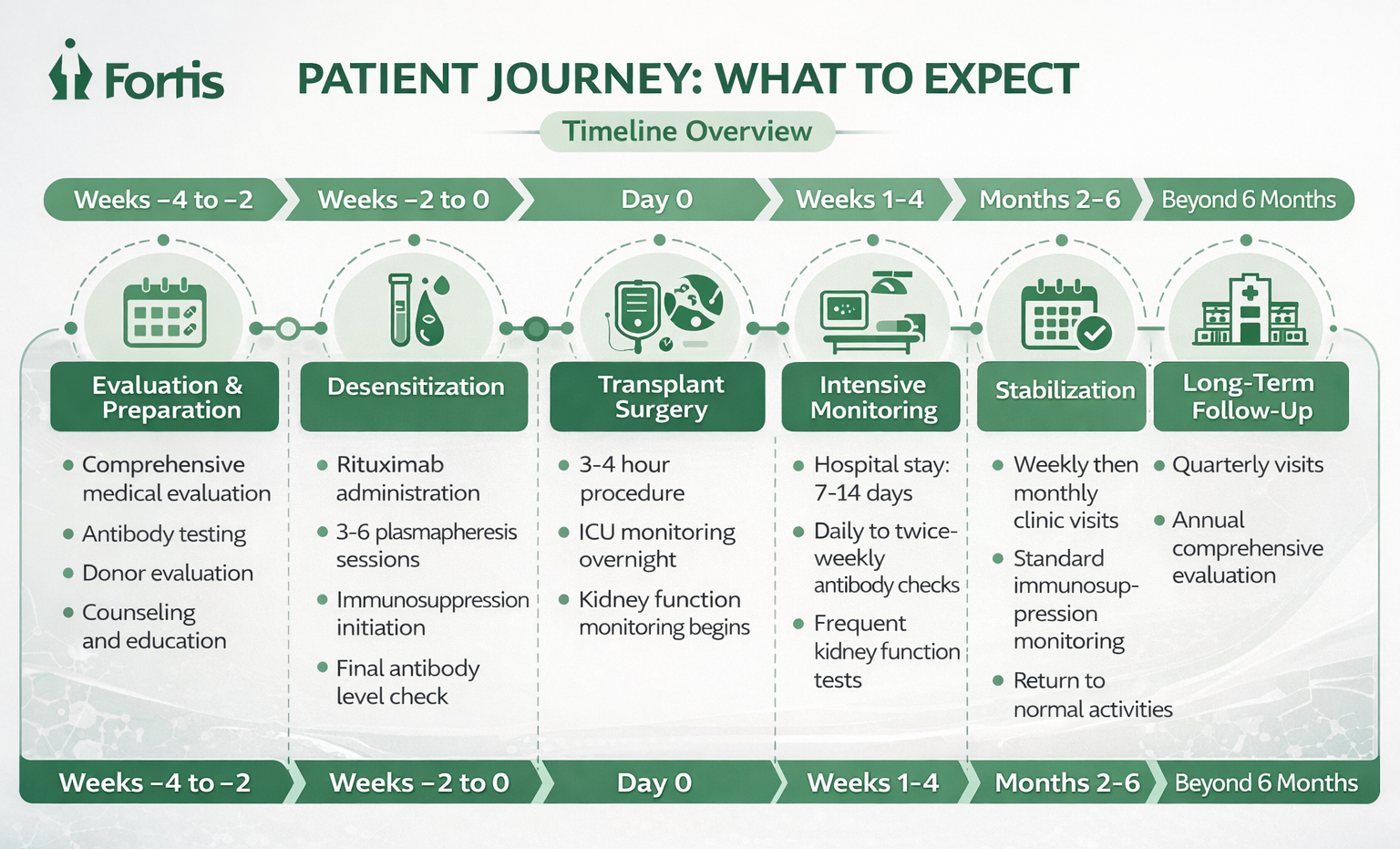
The typical timeline is:
- Initial evaluation: 1-2 weeks
- Desensitization (plasmapheresis + medications): 2-4 weeks
- Transplant surgery: Day 0
- Hospital stay: 7-14 days
- Total time from decision to discharge: Approximately 6-10 weeks
This is significantly faster than waiting years on a transplant list for a compatible donor.
How long will I stay in the hospital?
Hospital stay for ABO incompatible transplants is typically 7-14 days, slightly longer than compatible transplants (5-10 days). The extra time allows for:
- Close antibody monitoring
- Early detection of any complications
- Additional plasmapheresis if needed
- Ensuring kidney function is stable
When can I return to normal activities after the transplant?
- Light activities: 2-3 weeks
- Driving: 3-4 weeks (when off pain medications)
- Work (desk job): 6-8 weeks
- Exercise/sports: 3-6 months
- Full recovery: 3-6 months
This timeline is similar to compatible transplants. You'll feel significantly better than on dialysis within weeks.
Candidacy and Suitability Questions
Who is a candidate for an ABO incompatible transplant?
Good candidates include:
- Patients with end-stage kidney disease needing transplant
- Have a willing living donor whose blood type is incompatible
- Are healthy enough for major surgery
- Have no active infections or untreated cancer
- Can comply with intensive post-transplant monitoring and medications
Are there any conditions that would disqualify me?
Potential contraindications include:
- Active infection or untreated cancer
- Severe heart or lung disease making surgery unsafe
- Very high baseline antibody levels that don't respond to treatment
- Inability to comply with medications or follow-up
Our team evaluates each case individually to determine suitability.
Can elderly patients undergo ABO incompatible transplants?
Yes. Age alone is not a contraindication. We have successfully transplanted patients in their 60s and 70s. What matters more is overall health status, organ function, and ability to tolerate the procedure and medications. Each case is evaluated individually.
Can children receive ABO incompatible transplants?
Yes. ABO incompatible transplantation is successfully performed in children, even infants. In fact, younger patients often have better outcomes due to their developing immune systems. Pediatric transplant protocols are specialized and require experienced teams.
What if I've had previous transplants that failed?
Previous transplant history doesn't automatically disqualify you from an ABO incompatible transplant. However, you may have additional antibodies (not just ABO antibodies) that need evaluation and management. Our immunology team will assess your antibody profile and determine if desensitization is possible.
Donor Questions
Can anyone be my donor for an ABO incompatible transplant?
The donor must:
- Be a blood relative or spouse (per Indian law - Transplantation of Human Organs Act)
- Be between 18-65 years old (ideally)
- Be in good health with normal kidney function
- Have compatible tissue type (HLA matching helps but isn't mandatory)
- Pass medical, psychological, and legal evaluation
Blood group incompatibility is no longer a barrier.
What blood type combinations are possible?
Previously Impossible, Now Possible:
- Blood group A recipient can receive from B or AB donor
- Blood group B recipient can receive from A or AB donor
- Blood group O recipient can receive from A, B, or AB donor
- Blood group AB recipient can receive from anyone (always was universal recipient)
Does the donor need any special preparation?
No. The donor undergoes standard living donor evaluation and preparation. All the special procedures (plasmapheresis, desensitization) are only for the recipient. The donor's surgery and recovery are identical to any living kidney donation.
Will the donor's life be affected by donating an incompatible kidney?
No. Kidney donation (whether compatible or incompatible) doesn't affect the donor's long-term health or life expectancy. Donors live normal, healthy lives with one kidney. The blood type incompatibility only matters for the recipient, not the donor.
Long-Term Questions
Will I need plasmapheresis for the rest of my life?
No. Plasmapheresis is typically only needed:
- Before transplant: 3-6 sessions over 2-3 weeks
- After transplant: Occasionally in the first 3-4 weeks if antibody levels rebound
- Beyond one month: Rarely needed due to accommodation
Most patients never need plasmapheresis again after the first month post-transplant.
What medications will I need to take long-term?
You'll take the same immunosuppression medications as any transplant recipient:
- Tacrolimus or Cyclosporine: Primary immunosuppressant
- Mycophenolate: Secondary immunosuppressant
- Prednisone: Steroid (tapered over time, some patients discontinue)
These medications prevent rejection and are lifelong. ABO incompatible transplant recipients don't require different long-term medications than compatible transplant recipients.
How often will I need follow-up appointments?
- First month: 2-3 times per week
- Months 2-3: Weekly
- Months 4-6: Every 2 weeks
- Months 7-12: Monthly
- Beyond 1 year: Every 3 months
This schedule is similar to compatible transplants, with more frequent visits only in the first month.
Can I live a normal life after an ABO incompatible transplant?
Absolutely. After the first 3-6 months, most patients:
- Return to work full-time
- Exercise regularly
- Travel freely
- Have children (with medical guidance)
- Enjoy hobbies and social activities
The only ongoing requirements are taking medications and regular follow-up. Quality of life is dramatically better than on dialysis and comparable to the general population.
What are the long-term success rates?
Long-term outcomes for ABO incompatible transplants are excellent:
- 5-year kidney survival: 85-90%
- 10-year kidney survival: 70-75%
- Patient survival: >90% at 10 years
These rates are nearly identical to compatible transplants, proving that blood type incompatibility doesn't affect long-term success.
Fortis Mohali-Specific Questions
How experienced is Fortis Mohali with ABO incompatible transplants?
Fortis Mohali is the regional pioneer and leader in ABO incompatible transplantation:
- First center in Tricity and surrounding region to offer this procedure
- Over 200 successful ABO incompatible transplants performed
- Outcomes matching international benchmarks
- Experienced team trained at leading international centers
This extensive experience translates to better outcomes and fewer complications.
What makes Fortis Mohali's ABO incompatible transplant program unique?
- Robotic kidney transplant capability: Minimally invasive surgery option for faster recovery
- 24/7 antibody testing: In-house laboratory for immediate results
- Dedicated apheresis unit: Specialized plasmapheresis equipment and expert staff
- Multidisciplinary tumor board: Collaborative approach to complex cases
- JCI accreditation: Ensuring international quality standards
- Comprehensive support: From evaluation through lifelong follow-up
Do you accept patients from outside the region?
Yes. We regularly treat patients from across North India and neighboring states. Our international patient services team assists with:
- Travel arrangements
- Accommodation for family
- Coordination of care
- Medical visa documentation (for international patients)
Can I get a second opinion on my transplant candidacy?
Absolutely. We encourage patients to seek second opinions. We offer:
- Comprehensive evaluation review
- Discussion of all treatment options
- Transparent discussion of risks and benefits
- No-obligation consultations
Our goal is informed decision-making, not pressuring patients into procedures.
How do I get started with evaluation for an ABO incompatible transplant?
Step 1: Call our transplant coordinator at +91 72728 72728
Step 2: Schedule an initial consultation with our transplant nephrologist
Step 3: Bring all medical records, recent blood work, and imaging
Step 4: Meet with our multidisciplinary team for comprehensive evaluation
Step 5: Receive a detailed plan with timelines, costs, and next steps
We aim to complete initial evaluation within 1-2 weeks.
TAKE THE NEXT STEP
Don't Let Blood Type Stand in the Way of a New Life
If you or a loved one needs a kidney transplant and has a willing donor whose blood type is incompatible, don't lose hope. ABO incompatible transplantation can make the impossible possible.
Schedule a consultation with India's most experienced ABO incompatible transplant team:
Phone: +91 72728 72728
Email: [email protected]
Location: Fortis Hospital Mohali
Sector 62, Phase VIII, Sahibzada Ajit Singh Nagar, Punjab 160062
ABOUT OUR TRANSPLANT TEAM
Department of Nephrology & Kidney Transplantation
Our multidisciplinary team includes:
- Transplant nephrologists
- Transplant surgeons (including robotic surgery expertise)
- Immunologists
- Apheresis specialists
- Transplant coordinators
- Specialized transplant nurses
- Dietitians and counselors
REFERENCES & FURTHER READING
- Transplantation Society Guidelines on ABO Incompatible Transplantation
- Indian Society of Nephrology - Kidney Transplantation Guidelines
- International literature on ABO incompatible transplant outcomes
- Patient education resources from leading transplant centers
Dr Amit Sharma
https://www.fortishealthcare.com/doctors/dr-amit-sharma-1657
Disclaimer: This information is for educational purposes. Individual treatment recommendations depend on comprehensive evaluation by our specialized transplant team. Always consult with qualified medical professionals for personalized medical advice.
Categories
Clear allMeet the doctor

- Organ Transplant | Kidney Transplant
- Nephrology | Nephrology
-
 16 Years
-
 1600
1600
Related Blogs
View all







Keep track of your appointments, get updates & more!

