
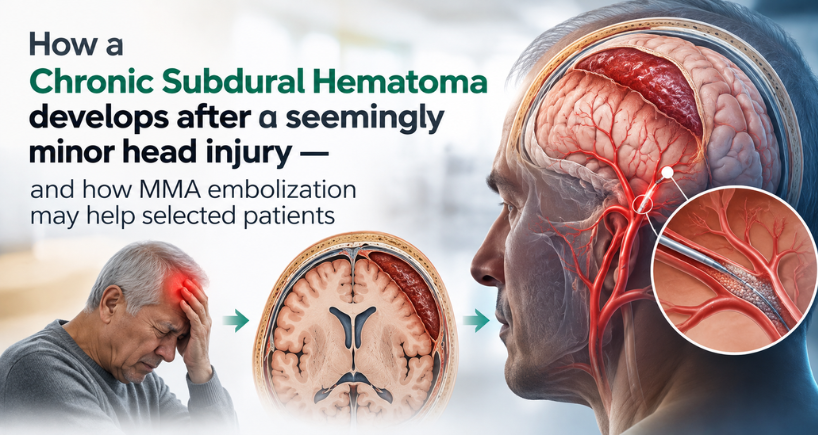


The Brain Bleed That Can Look Like Dementia - Fortis Mohali
By Dr (Prof.) Vivek Gupta | Director, Interventional Neuroradiology, Fortis Hospital, Mohali | Medically reviewed by Prof (Dr) Vivek Gupta · Review date: 12 October 2026

An elderly parent becomes forgetful, unusually sleepy or unsteady on their feet. Perhaps one arm feels weak, speech becomes hesitant, or the family notices a change in personality. Because these changes creep in gradually, they are often put down to ageing or dementia. Sometimes, however, the real cause is a slow collection of blood pressing on the brain — a chronic subdural hematoma.
This matters because, unlike a degenerative dementia, a chronic subdural hematoma is a structural problem that can often be treated — with monitoring, surgical drainage, or a minimally invasive procedure called middle meningeal artery (MMA) embolization. At Fortis Hospital, Mohali, chronic subdural hematoma treatment is available for patients across Mohali, Chandigarh, Panchkula and the wider tricity, with a neurovascular team that assesses each patient individually.
A minor bump that is easy to forget
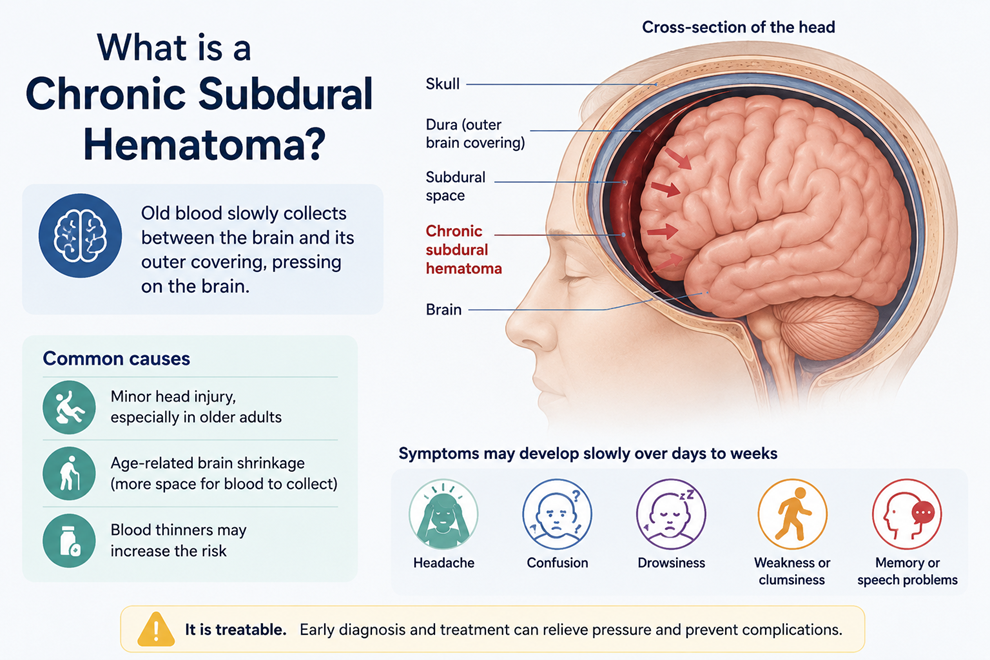
A chronic subdural hematoma is a collection of old blood and fluid between the brain and the dura — the tough membrane lining the inside of the skull. It usually builds up gradually over several weeks, sometimes months, after an injury that seemed insignificant at the time. The trigger may be as simple as slipping in the bathroom, knocking the head on a cupboard door, falling while getting out of bed, or losing balance while walking. Sometimes there is no clearly remembered blow to the head at all.
There is a reason older adults are more vulnerable. With age, the brain occupies slightly less space inside the skull, which stretches the small bridging veins running between the brain and its outer covering. Stretched veins tear more easily, so even a low-impact knock can start a slow ooze of blood — and the person may seem perfectly well for days or weeks afterwards.
Why families mistake it for dementia
Unlike a dramatic acute bleed, a chronic subdural hematoma announces itself quietly. As the collection slowly enlarges, it presses on the brain and a previously independent person may begin to show growing forgetfulness or confusion, excessive sleepiness, changes in behaviour or personality, difficulty concentrating, new imbalance or repeated falls, a persistent headache, slurred speech or trouble finding words, weakness or numbness on one side, facial drooping, or even seizures.
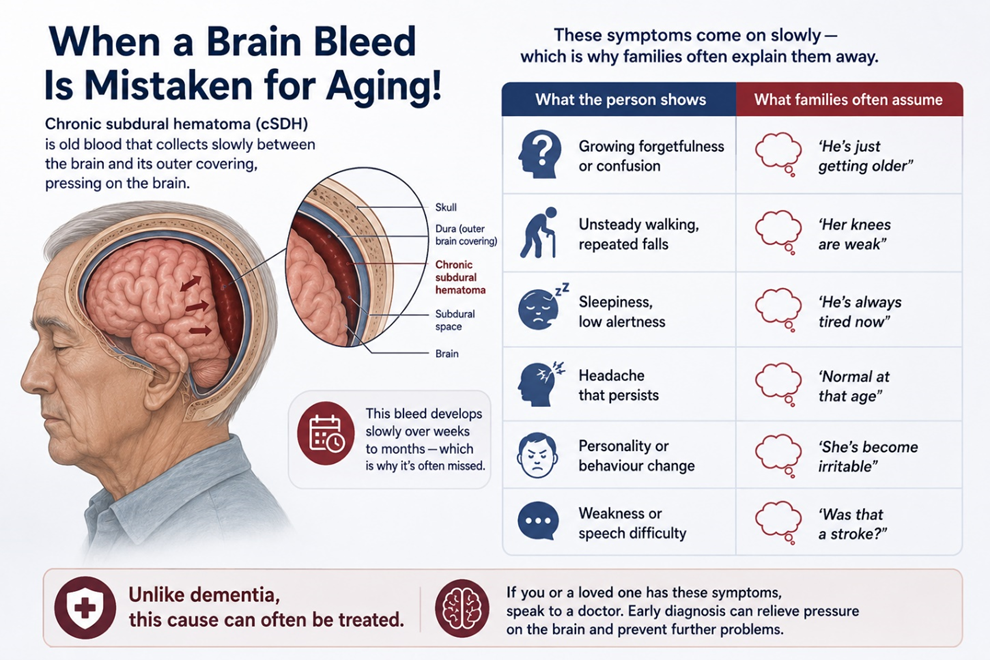
These symptoms can closely resemble dementia, stroke, Parkinsonism or a general decline of old age. Confusion on its own is not specific to a subdural hematoma — but confusion together with headache, weakness, speech difficulty, drowsiness or worsening balance should always raise the question. A brain CT scan can answer it quickly.
Who is at greater risk?
While this can occur at any age, it is seen most often in older adults. The risk is higher in people who:
- Take blood-thinning or antiplatelet medicines — including warfarin, apixaban, aspirin or clopidogrel
- Have had recent falls or head injuries
- Have a blood-clotting disorder
- Drink alcohol heavily
- Are frail or living with several medical conditions

When should you take the patient to hospital?
Seek urgent emergency assessment if a person develops any of the following after a fall or head injury — even if that injury happened days or weeks earlier:
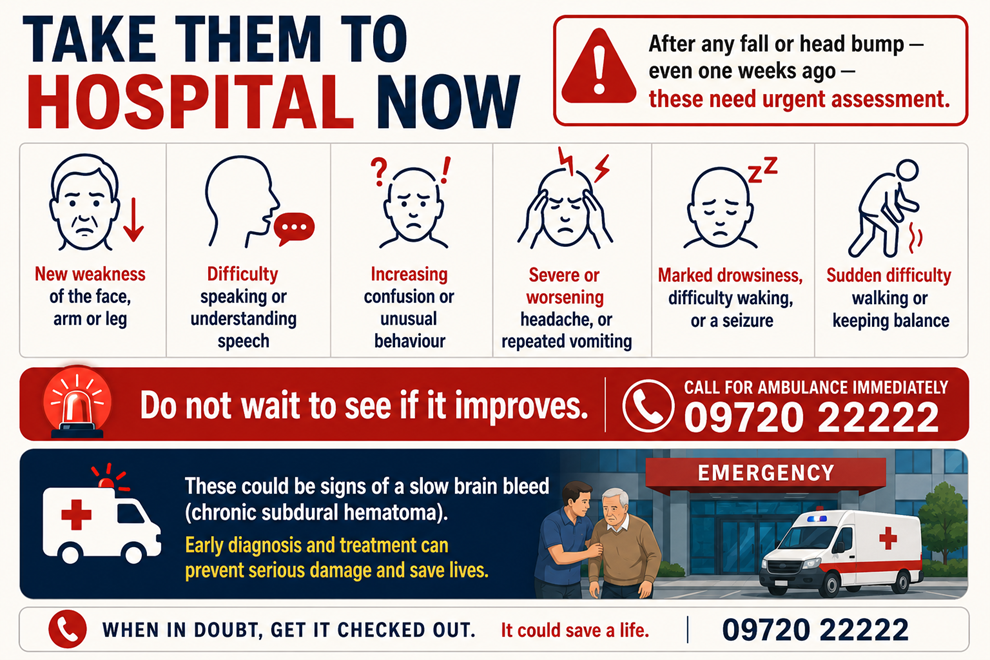
A sudden facial droop, arm weakness or speech problem must be treated as a possible stroke or brain bleed — do not wait to see whether it improves. Patients taking blood-thinning medicines warrant particular caution after any head injury. Diagnosis normally involves a neurological examination and brain imaging, most commonly a CT scan.
How is a chronic subdural hematoma treated?
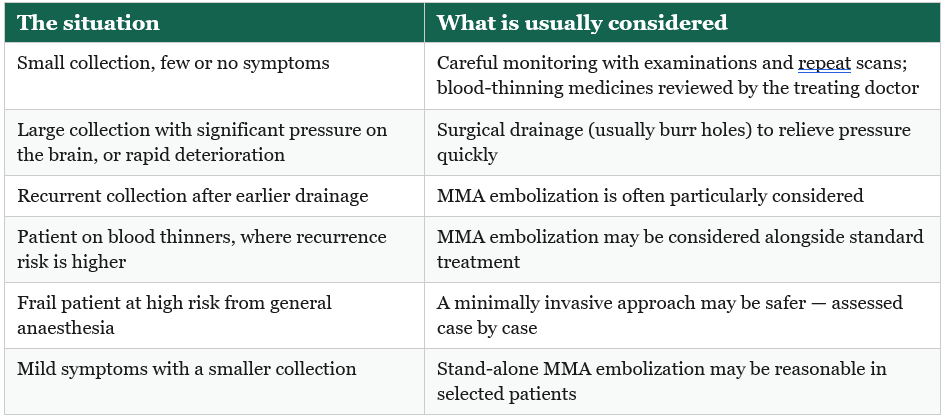
Treatment depends on the symptoms, the size and appearance of the collection, how much pressure it is putting on the brain, other medical conditions, and the medicines the patient takes. Broadly, there are three approaches — and they are often combined.
1. Careful observation. A small collection causing no symptoms, or only very mild ones, may be monitored with clinical examination and repeat scans, with blood-thinning medicines reviewed by the treating doctor.
2. Surgical drainage. A large or symptomatic collection may need urgent drainage. Most commonly, one or two small openings called burr holes are made in the skull so the old blood can drain out, sometimes with a temporary drain left in place. A larger operation is occasionally needed. Surgery relieves the pressure quickly — but the collection can come back, because draining the fluid does not always deal with the fragile blood vessels in the surrounding membranes that keep feeding it.
3. MMA embolization. This minimally invasive procedure targets exactly that problem — the blood supply that sustains the collection.
What is MMA embolization?
The middle meningeal artery is the vessel that supplies the dura. In a chronic subdural hematoma, this artery and its branches feed the inflamed, leaky membranes around the collection — fragile new vessels that keep oozing and keep the hematoma going. Middle meningeal artery embolization is designed to interrupt that cycle.
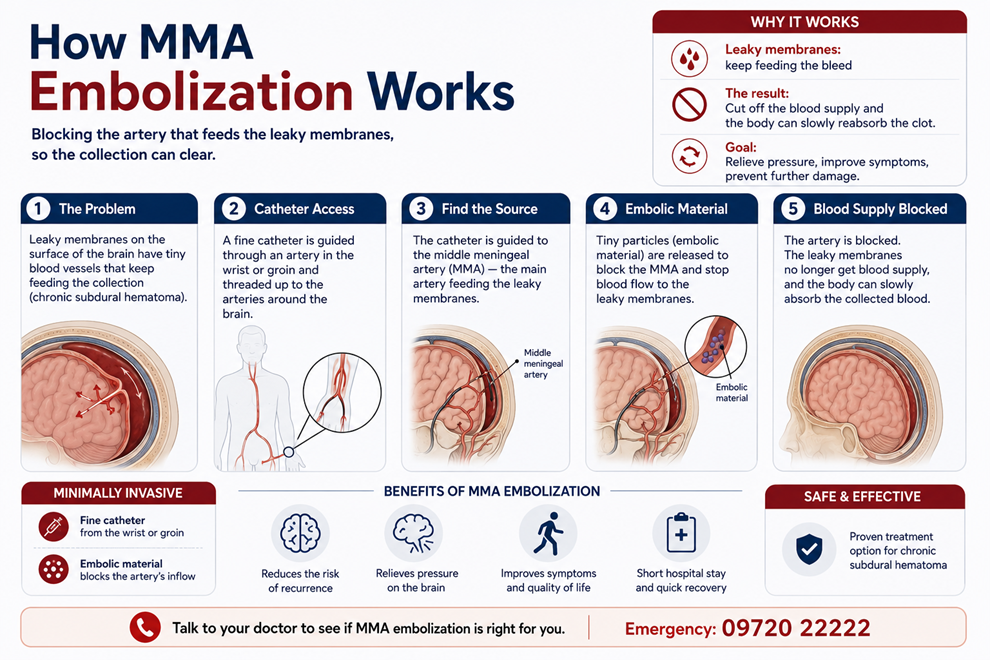
As with the other procedures in this series, the specialist guides a fine catheter through an artery — usually from the wrist or groin — up towards the middle meningeal artery. After studying the vessel anatomy carefully and checking for connections that could be hazardous, an embolic material is delivered to reduce the blood flow to those abnormal membranes. It is generally performed under local anaesthesia with light sedation, and many patients are comfortable and communicative throughout.
Put simply: surgical drainage removes the blood that has already collected, while MMA embolization reduces the blood supply that causes it to persist or come back.
Is MMA embolization a replacement for surgery?
Not for every patient. When a large collection is causing significant pressure, rapid deterioration or severe weakness, surgical drainage may still be urgently necessary — and embolization is then considered as an additional treatment to lower the chance of recurrence. Current specialist guidance gives its strongest support to embolization used as an adjunct to surgical drainage. Stand-alone embolization may be reasonable in carefully selected situations — for instance in some elderly patients, or those considered high risk for surgery — but that selection and the procedural risk must be judged by an experienced multidisciplinary team.
What does the evidence show?
Several randomized trials have now tested this approach. In the EMBOLISE trial, among patients with symptomatic subacute or chronic subdural hematoma who required surgical evacuation, recurrence or progression leading to another operation occurred in about 4.1% of those treated with surgery plus MMA embolization, compared with 11.3% of those treated with surgery alone.

The STEM trial reported a similar direction of benefit on its combined outcome measure. It is worth being straightforward about the whole picture, though: the MAGIC-MT trial found a smaller difference that did not reach statistical significance, and pooled analyses suggest the clearest benefit is in reducing recurrence and repeat procedures rather than in changing overall functional recovery — with the effect appearing strongest in patients managed without surgery. Serious embolization-related events occurred in a small proportion of patients, around 2% by 30 days in EMBOLISE.
A consensus guideline from the Society of Vascular and Interventional Neurology recommends considering adjunctive MMA embolization to reduce the risk of recurrence needing further intervention, and stresses examining the arterial anatomy for dangerous collateral vessels beforehand. In short: the evidence is encouraging and this is now a well-established option — but it is not a one-size-fits-all treatment.
Not every case needs a procedure
Some small collections in stable patients with few symptoms can simply be watched with repeat imaging, particularly when the person is not on blood thinners. The right approach is accurate diagnosis and honest risk assessment — not automatic treatment. The choice between observation, surgery, embolization or a combination should follow from the scan findings, the severity and urgency of symptoms, and the patient’s overall condition.
Why Fortis Hospital, Mohali
MMA embolization demands precise study of the arterial anatomy before anything is delivered, because branches of this artery can connect to vessels supplying the eye or cranial nerves. Fortis Mohali brings together a multidisciplinary neurovascular team — neurologists, interventional neuroradiologists, neurosurgeons and anaesthetists — and a bi-plane cath lab, the only one in a private hospital north of Delhi, which captures two X-ray views simultaneously for greater precision and less contrast dye. Neuro-interventional and comprehensive stroke services are available 24×7 for patients across Mohali, Chandigarh, Panchkula and the tricity.
Early recognition can change the outcome
The most important message for families is a simple one: do not assume that new confusion, weakness, drowsiness or loss of balance in an elderly person is “just ageing.” A forgotten fall or minor head bump weeks earlier may be the clue — and this matters even more when the person takes medication affecting blood clotting. Timely brain imaging can identify a chronic subdural hematoma, and once it is diagnosed, treatment can be genuinely life-restoring.
Myth vs Fact
Confusion and unsteadiness in an elderly person are just part of ageing. Not always. A slow brain bleed can cause exactly these symptoms — and unlike dementia, it can often be treated. New or worsening confusion deserves a proper assessment.
There was no serious fall, so a brain bleed is impossible. The trigger is often trivial — a bump against a door, a slip in the bathroom — and may have happened weeks earlier and been forgotten entirely.
If it were a brain bleed, symptoms would appear immediately. A chronic subdural hematoma builds up gradually over weeks or months. The person may seem fine for a long time after the injury.
We should stop the blood thinners straight away. Never stop these on your own. They may be preventing a stroke or heart attack. Only the treating doctor can balance the risks and decide.
MMA embolization replaces surgery for everyone. No. When a large collection is pressing on the brain, surgical drainage may still be needed urgently. Embolization is most often used alongside it to lower the chance of recurrence.
Every chronic subdural hematoma needs a procedure. No. Small collections causing little or no trouble may simply be monitored with repeat scans. The aim is accurate assessment, not automatic treatment.
Has an elderly family member changed after a fall?
Confusion, weakness, drowsiness or imbalance in an older adult after a recent fall or minor head injury deserves a proper neurological assessment — not the assumption of dementia. Book a consultation with Prof (Dr) Vivek Gupta at Fortis Hospital, Mohali to have the cause identified and the right treatment discussed.
Call 72728 72728 | New weakness, speech difficulty, seizure or worsening drowsiness? Go to the emergency department immediately.
About the Author
Prof (Dr) Vivek Gupta
Director, Interventional Neuroradiology, Fortis Hospital, Mohali
Prof (Dr) Vivek Gupta is a senior interventional neuroradiologist with over 20 years of experience in minimally invasive neurovascular treatment, including stroke intervention, brain-aneurysm treatment and embolization procedures. He holds an MD in Radiology and a DM in Neuroimaging and Interventional Neuroradiology from PGIMER, Chandigarh, and previously served as Professor and in-charge of the neuro-intervention program there. At Fortis Mohali he leads a 24×7 neurovascular service equipped with a bi-plane cath lab — the only one in a private hospital north of Delhi.
Categories
Clear allRelated Blogs
View all

Non-Surgical Treatment For Uterine Fibroid

Stenting for Carotid Artery Disease : Why you need a Second opinion in Mohali

Neurovascular and Neurointerventional Radiology Hospital in Mumbai
Tingling Numbness or a Mini-Stroke? When Carotid Artery Disease Needs Attention

FAQs
Can a chronic subdural hematoma really be mistaken for dementia?
Yes, and it often is. Because the symptoms — forgetfulness, confusion, sleepiness, unsteadiness, personality change — come on gradually in an older person, families and even doctors may put them down to ageing or dementia. A brain CT scan settles the question quickly.
My father had a small bump weeks ago and seems fine. Should I worry?
Most minor bumps cause no problem. But if he later develops new confusion, drowsiness, headache, weakness, speech difficulty or unsteadiness — especially if he takes blood-thinning medicines — he needs prompt medical assessment.
Should blood thinners be stopped after a head injury?
Never on your own. These medicines may be protecting against stroke or heart attack. The treating team weighs the risk of further bleeding against the risk of clotting and decides individually.
Is MMA embolization a replacement for surgery?
Usually not. When a large collection is pressing on the brain or the person is deteriorating, surgical drainage may still be needed urgently. Embolization is most often used alongside surgery to reduce the chance of the collection coming back, and stand-alone use is reserved for carefully selected patients.
How is MMA embolization done, and what is recovery like?
A fine catheter is passed from the wrist or groin up to the middle meningeal artery, and an embolic material is injected to block the supply to the leaky membranes. It is done under local anaesthesia with light sedation, and many patients go home the same or next day. The collection then clears gradually over weeks, with follow-up scans.
Can the symptoms actually improve?
In many patients, yes. Unlike a degenerative dementia, this is a structural problem — relieving the pressure and stopping the bleeding cycle can allow alertness, memory and walking to improve. Recovery varies with age, general health and how long the pressure was present.

Keep track of your appointments, get updates & more!

