
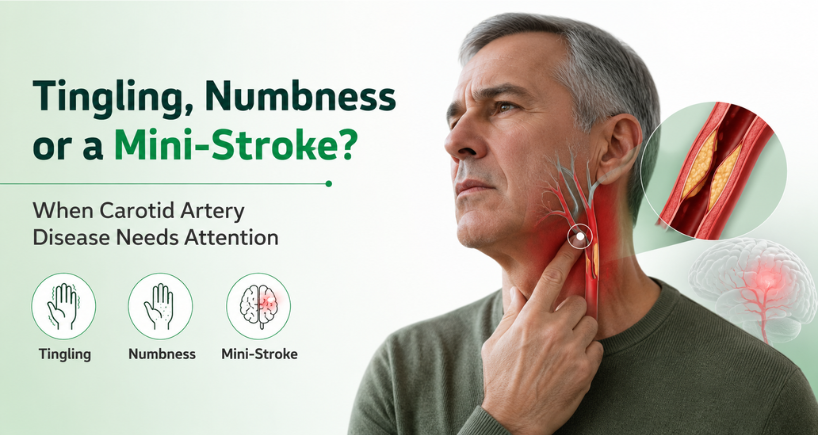


Tingling Numbness or a Mini-Stroke? When Carotid Artery Disease Needs Attention
How a narrowed neck artery can quietly raise your stroke risk — and how early assessment, a carotid Doppler and carotid stenting can help
By Dr (Prof.) Vivek Gupta | Director, Interventional Neuroradiology, Fortis Hospital, Mohali | Medically reviewed by Prof (Dr) Vivek Gupta · Review date: 03-09-2026

In our previous article, we looked at how a stroke is treated once it strikes — with rapid imaging and, in selected cases, a clot-removal procedure. But the best stroke is the one that never happens. This article is about the other side of the story: preventing a stroke by catching a warning sign early.
A sudden tingling sensation in the face, arm or leg is often brushed off as "a pinched nerve", "sleeping awkwardly" or simple tiredness. Usually it is harmless. But when tingling or numbness affects one side of the body — especially alongside facial drooping, weakness, difficulty speaking, loss of vision or imbalance — it can be a warning sign of a transient ischaemic attack (TIA), often called a mini-stroke.
One possible cause is narrowing of the carotid arteries — the major blood vessels in the neck that carry oxygen-rich blood to the brain. Narrowing builds up silently over years and may cause no symptoms at all until a TIA or stroke occurs. The encouraging part: when it is identified in the right patient, it can be managed — with medicines, close monitoring, or in selected cases a procedure such as carotid stenting.
What are the carotid arteries?
You have two main carotid arteries, one on each side of the neck. Their job is to supply blood to the front part of the brain. Over the years, fatty deposits called plaque can build up inside the vessel wall and narrow the channel — this is known as carotid artery disease, or carotid stenosis.
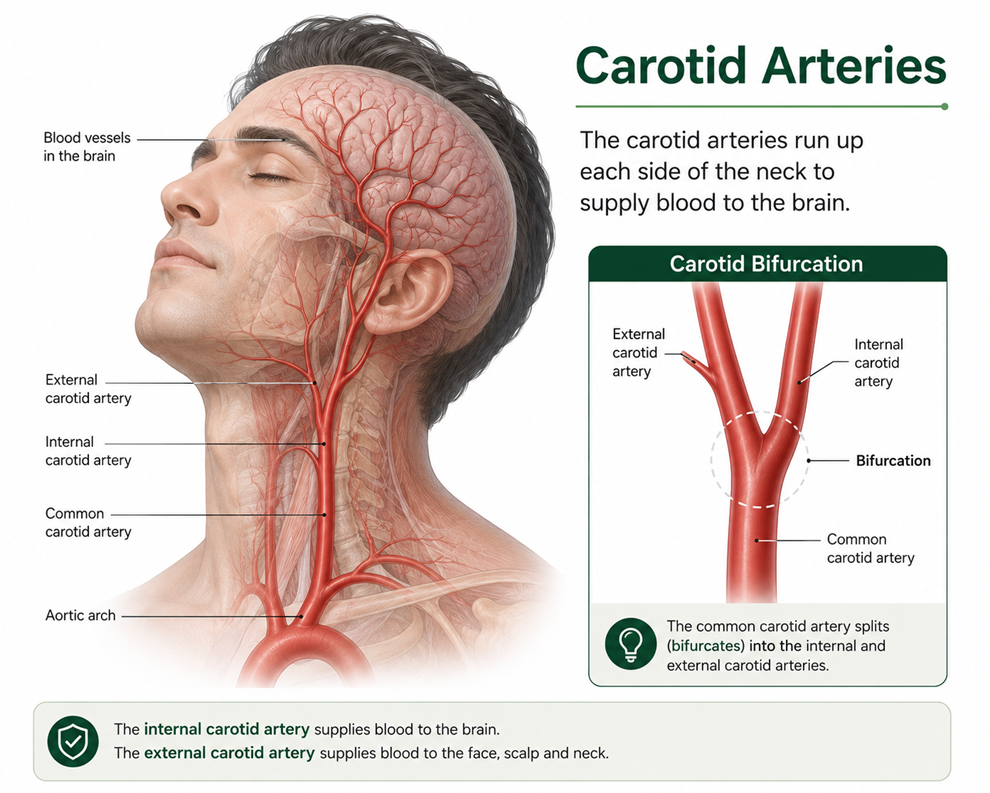
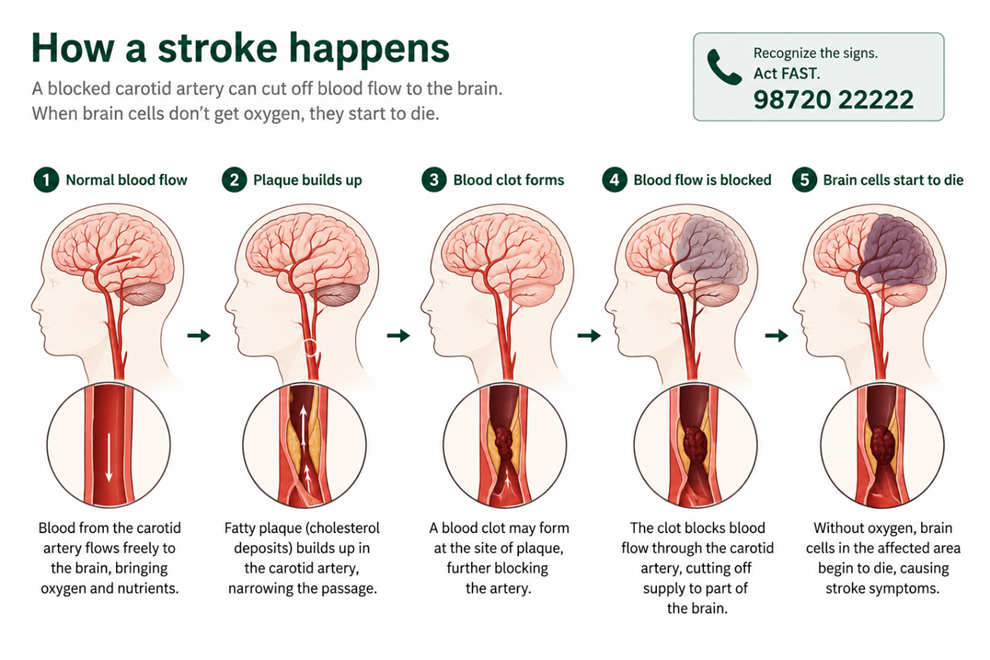
A narrowed artery can cause trouble in two ways: it can reduce blood flow to the brain, or a small piece of plaque or clot can break off and travel downstream, briefly blocking a smaller vessel. Think of the carotid artery as a main road to the brain: plaque narrows the road, and if debris breaks away, it can block a smaller road further along.
Can tingling be a warning sign?
This is the question that matters most, and it deserves a careful answer. Sudden tingling or numbness on one side of the face, arm or leg may be a TIA or stroke warning — particularly when it is new, comes on abruptly, or arrives with weakness or other focal symptoms.
At the same time, tingling on its own is very common and usually has nothing to do with the carotid arteries. It can come from a compressed nerve, migraine, anxiety, a vitamin deficiency, nerve damage (neuropathy) or a neck-spine problem. The point is not to panic over every tingle — it is to recognise the pattern that needs urgent attention, and not to self-diagnose a sudden, one-sided episode.
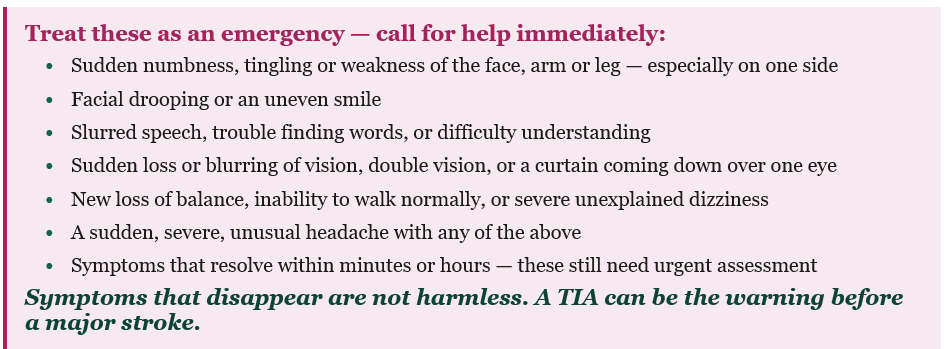
A quick way to recognise a stroke is the BE-FAST check — Balance, Eyes, Face, Arms, Speech, Time — which we covered in detail in our earlier article, "Stroke Is Treatable — If You Act Fast." The key point for carotid disease is simple: even if the symptoms pass within minutes, treat them as an emergency and note the time they began.
Who may be at higher risk?
Carotid artery disease is a form of atherosclerosis — the same process that affects the heart’s arteries. The risk is higher in people with:
- High blood pressure
- Diabetes
- High LDL ("bad") cholesterol
- Current or past tobacco use
- Heart disease, a prior heart attack, peripheral artery disease, or a previous stroke or TIA
- Increasing age
- A family history of early vascular disease
- A sedentary lifestyle, excess weight, and poorly controlled risk factors
These factors raise the likelihood of narrowing — but they are a reason to have a conversation with a doctor, not a reason to rush straight to a scan. Whether a carotid Doppler will help is a clinical decision, not a blanket rule.
What is a carotid Doppler?
A carotid Doppler is a painless, radiation-free ultrasound scan of the neck arteries. It measures blood flow and can show plaque and estimate how much an artery has narrowed. You simply lie back comfortably while a probe with ultrasound gel is moved over the neck — there are no needles, no radiation and no contrast dye.
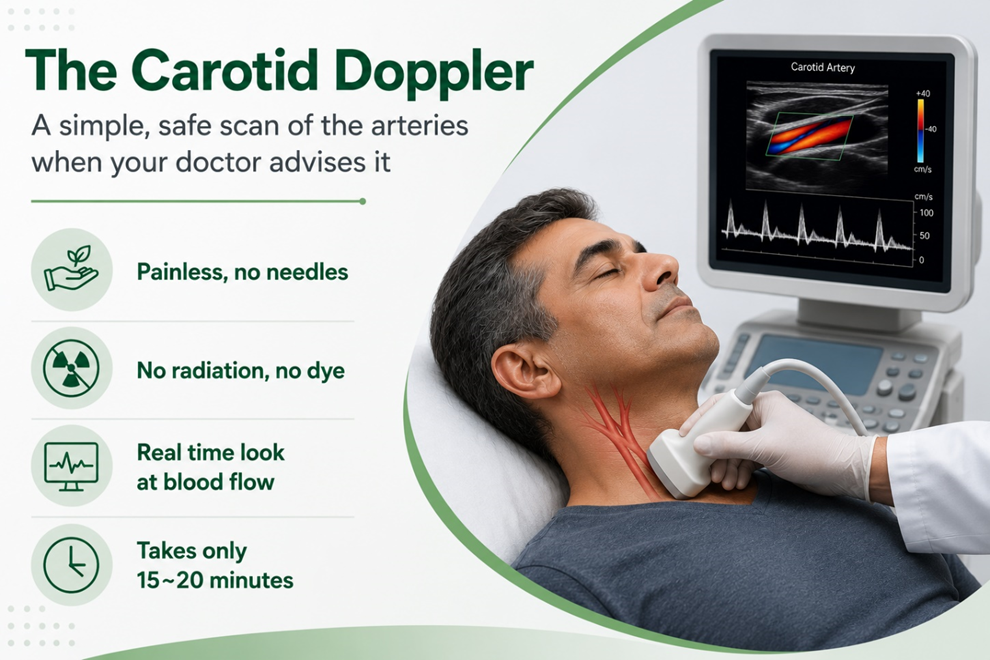
It is commonly used after a suspected TIA or stroke, when a doctor suspects carotid disease on examination, or to keep an eye on a narrowing that is already known. It is usually the first-line, non-invasive test; if more detail is needed to plan treatment, a CT angiogram, MR angiogram or catheter angiogram may follow.
Should you be assessed?
If you have risk factors or have had a warning episode, the right first step is a consultation — not a scan booked on your own. A short conversation and examination let the doctor decide whether a carotid Doppler is genuinely likely to help you. This matters: for people with no symptoms, leading guidelines advise against routine, blanket carotid screening, because it can lead to unnecessary tests and procedures.
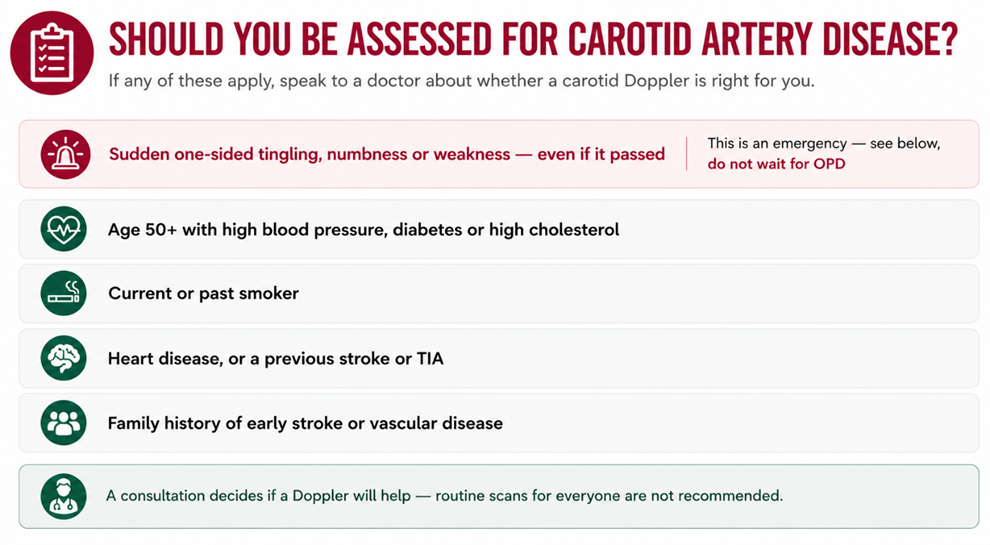
The table below is a simple guide to whether your situation calls for the emergency department, an urgent consultation, or a routine OPD visit.
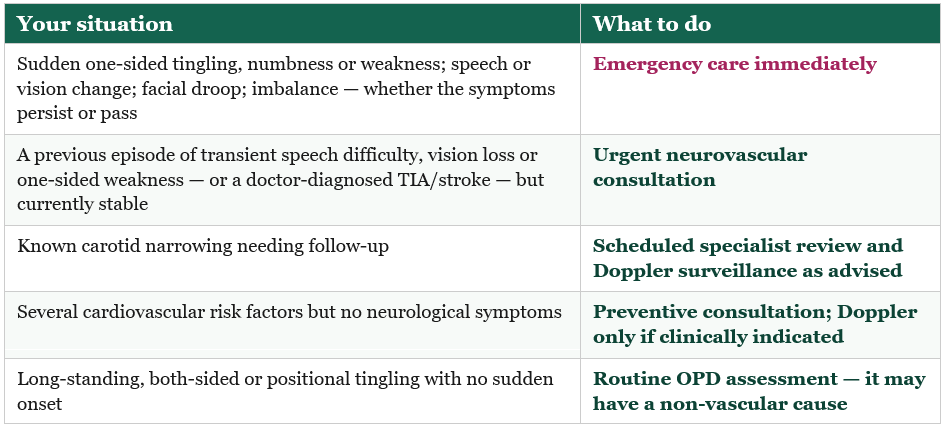
What happens if a narrowing is found?
Finding a narrowing does not automatically mean a procedure. Treatment depends on whether you have had symptoms, how tight and how risky the narrowing is, your age and other conditions, the anatomy, and the risks of any intervention.
Many people do well with best medical therapy: controlling blood pressure, lowering cholesterol, taking antiplatelet medicines when prescribed, managing diabetes, stopping tobacco, eating well, staying active, and having follow-up scans as advised. For selected patients with a clinically significant narrowing, a multidisciplinary neurovascular team may recommend a procedure to reopen the artery — either carotid endarterectomy (surgery) or carotid artery stenting.
Finding a narrowing does not automatically mean a procedure. Treatment depends on whether you have had symptoms, how tight and how risky the narrowing is, your age and other conditions, the anatomy, and the risks of any intervention.
Many people do well with best medical therapy: controlling blood pressure, lowering cholesterol, taking antiplatelet medicines when prescribed, managing diabetes, stopping tobacco, eating well, staying active, and having follow-up scans as advised. For selected patients with a clinically significant narrowing, a multidisciplinary neurovascular team may recommend a procedure to reopen the artery — either carotid endarterectomy (surgery) or carotid artery stenting.
What is carotid angioplasty and stenting?
Carotid artery stenting is a minimally invasive, catheter-based procedure that widens a narrowed carotid artery and improves blood flow to the brain — without an open incision in the neck.
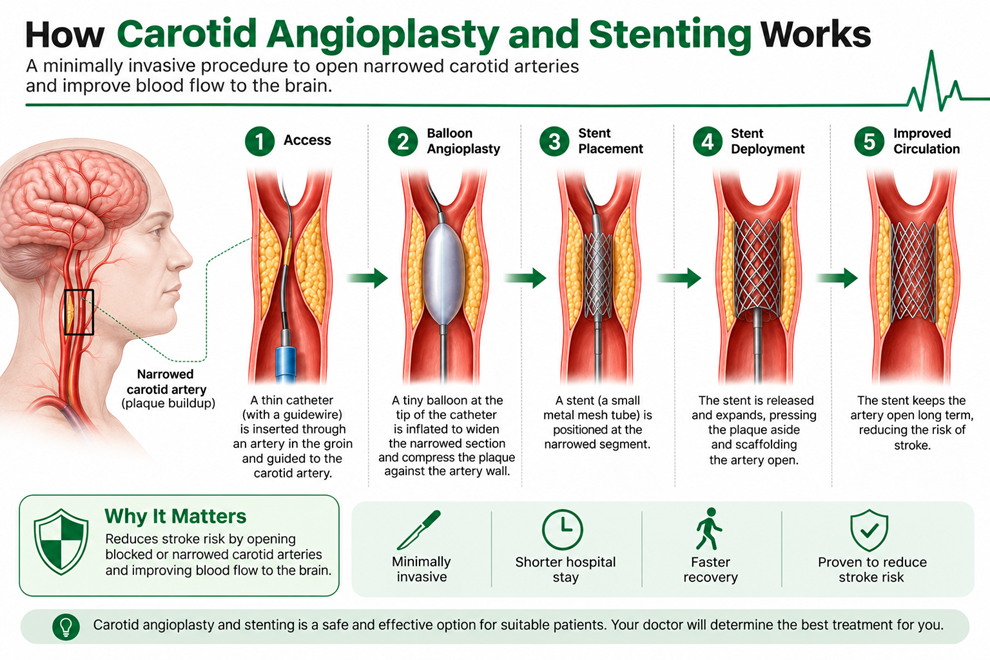
Working through a small puncture (usually at the wrist or groin), the specialist guides a fine catheter up to the narrowed segment. In suitable cases a small embolic-protection device is placed beyond the narrowing to catch any debris that might otherwise travel to the brain. A balloon may be used to open the narrowing, and a small mesh tube — a stent — is deployed to hold the artery open.
Stenting is not for everyone. It is weighed against surgery and against medicines, case by case. Carotid stenting is considered only after a detailed evaluation. The aim is to reduce stroke risk in carefully selected patients — not to treat every plaque seen on a scan.
Who might be considered for stenting?
Decisions are individualised, but stenting may be considered for:
- A patient with a recent TIA or stroke caused by a significant carotid narrowing
- Selected people with significant narrowing who are at higher surgical risk, or whose anatomy makes surgery less suitable
- Patients for whom the neurovascular team judges stenting the best option after reviewing the imaging and overall risk
There is no simple do-it-yourself cut-off. The preferred treatment depends on whether you have had symptoms, the imaging, your anatomy and age, and current guideline-based team assessment.
Benefits, risks and follow-up
Potential benefits in appropriately selected patients:
- Restores a wider channel for blood flow to the brain
- May reduce future stroke risk
- Performed through a catheter rather than an open neck operation, often with a shorter stay and quicker recovery
Important risks to understand:
- Stroke or TIA during or after the procedure
- Bleeding, bruising or vessel injury at the access site
- Temporary changes in blood pressure or heart rate
- Re-narrowing (restenosis) over time
- The need for antiplatelet medicines and regular follow-up imaging
No procedure is a guaranteed or permanent cure, and stenting is no exception. Its benefit depends on careful patient selection and on sticking with prescribed medicines and follow-up afterwards.
Why Fortis Hospital, Mohali
Carotid stenting is delicate work, performed close to the brain, and it benefits from the right equipment and a coordinated team. Fortis Mohali brings together a multidisciplinary neurovascular team and a bi-plane cath lab — the only one in a private hospital north of Delhi — which captures two X-ray views at once for greater precision and less contrast dye during complex neurovascular procedures. This service is available 24×7 for patients across Mohali, Chandigarh, Panchkula and the wider tricity.
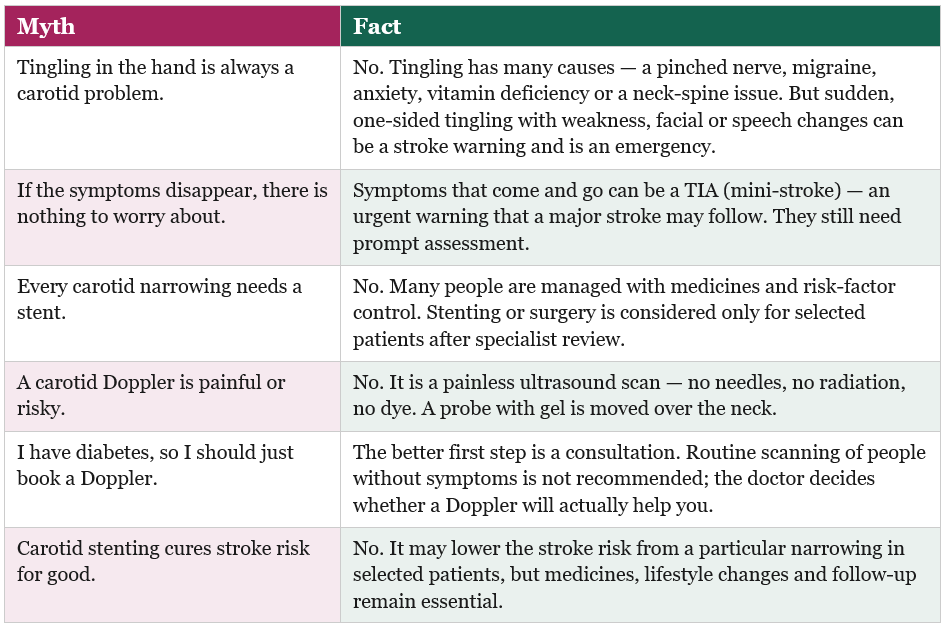
Myth vs Fact
Protect your brain health — with the right evaluation
About the Author
Prof (Dr) Vivek Gupta
Director, Interventional Neuroradiology, Fortis Hospital, Mohali
Prof (Dr) Vivek Gupta is a senior interventional neuroradiologist with over 20 years of experience in stroke intervention, carotid and brain-aneurysm treatment, and complex neurovascular procedures. At Fortis Mohali he leads a 24×7 neurovascular service equipped with a bi-plane cath lab — the only one in a private hospital north of Delhi.
Categories
Clear allRelated Blogs
View all
Non-Surgical Treatment For Uterine Fibroid
Stenting for Carotid Artery Disease : Why you need a Second opinion in Mohali

Neurovascular and Neurointerventional Radiology Hospital in Mumbai

What Are the Diagnostic Services Provided by Delhi Hospitals?
FAQs
Is tingling in the hand always related to a carotid blockage?
No — tingling has many possible causes. But sudden, one-sided tingling, especially with weakness, facial changes, speech trouble or vision loss, is an emergency because it may signal a TIA or stroke.
Can a carotid blockage cause symptoms that come and go?
Yes. Temporary neurological symptoms can be a TIA and should be treated as an urgent warning sign, not a false alarm.
Does every carotid narrowing need a stent?
No. Many people are treated with medicines and risk-factor control. Stenting or surgery is recommended only for selected patients after specialist review.
Is a carotid Doppler painful?
No. It is a non-invasive ultrasound using gel and a probe on the neck — no needles, radiation or dye.
I have diabetes and high cholesterol — can I just book a Doppler?
The better first step is a consultation. Routine screening of people without symptoms is not generally recommended; the doctor will decide whether a Doppler is likely to help you.
Does carotid stenting cure stroke risk?
No. It may reduce the stroke risk from a particular narrowing in selected patients, but continued medicines, lifestyle measures and follow-up remain important.

Keep track of your appointments, get updates & more!

