
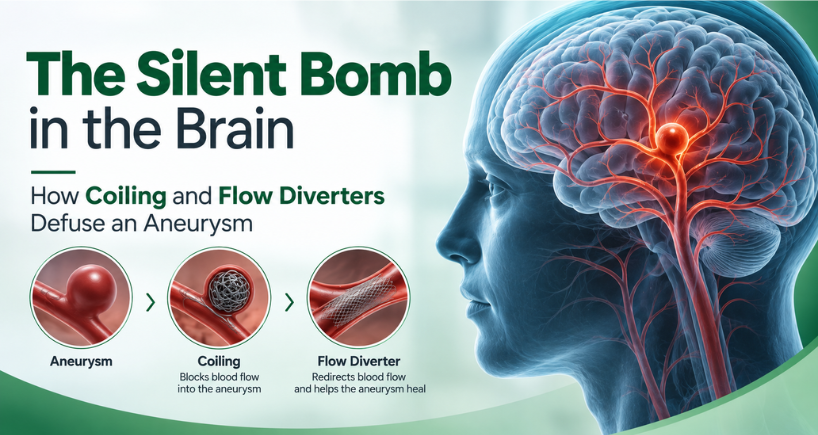


The Silent Bomb in the Brain - How Coiling and Flow Diverters Defuse an Aneurysm
A brain aneurysm can sit silently for years — but modern, minimally invasive treatment can often secure it from inside the blood vessel, without open surgeryBy Dr (Prof.) Vivek Gupta | Director, Interventional Neuroradiology, Fortis Hospital, Mohali | Medically reviewed by Prof (Dr) Vivek Gupta · Review date: 17 sep 2026

It may sit silently for years, often discovered only during a scan for something unrelated. But if a brain aneurysm ruptures, it can cause a life-threatening bleed within seconds. The encouraging news is that modern endovascular treatments can often secure an aneurysm from inside the blood vessel — without open-brain surgery.
The "silent bomb" image is attention-grabbing, and it makes an important point about detection. But it needs two calming facts alongside it: many unruptured aneurysms never rupture and may only need monitoring, and the decision to watch or to treat depends on the aneurysm’s size, shape, location, growth and rupture status — together with your age, health and other risk factors. A diagnosis is not a sentence; it is a reason for careful, expert evaluation.
What is a brain aneurysm?
A brain aneurysm is a weakened area in the wall of a brain artery that balloons outward — a little like a bulge forming on a worn garden hose. Many aneurysms cause no symptoms at all and are found by chance on a scan done for another reason. A larger one may press on nearby nerves and cause a drooping eyelid or double vision. If an aneurysm ruptures, it bleeds around the brain — most often a subarachnoid haemorrhage, which is a medical emergency.
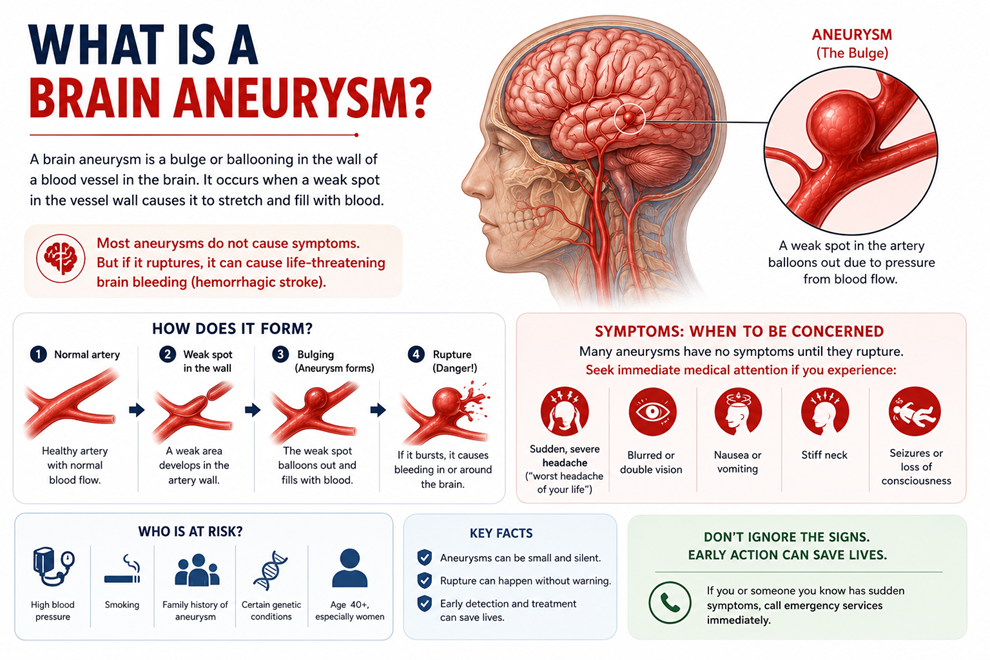
Why is it called “silent”?
No ticking sound. Often no warning. Most aneurysms give no signal until — and unless — they bleed. It is worth being clear about what "silent" does not mean: it does not mean every aneurysm is certain to rupture. The word simply underlines why detection and expert assessment matter, rather than implying inevitable disaster.
When every second matters
While aneurysms are usually silent, a rupture is sudden and dramatic. Seek emergency medical care straight away for any of the following:
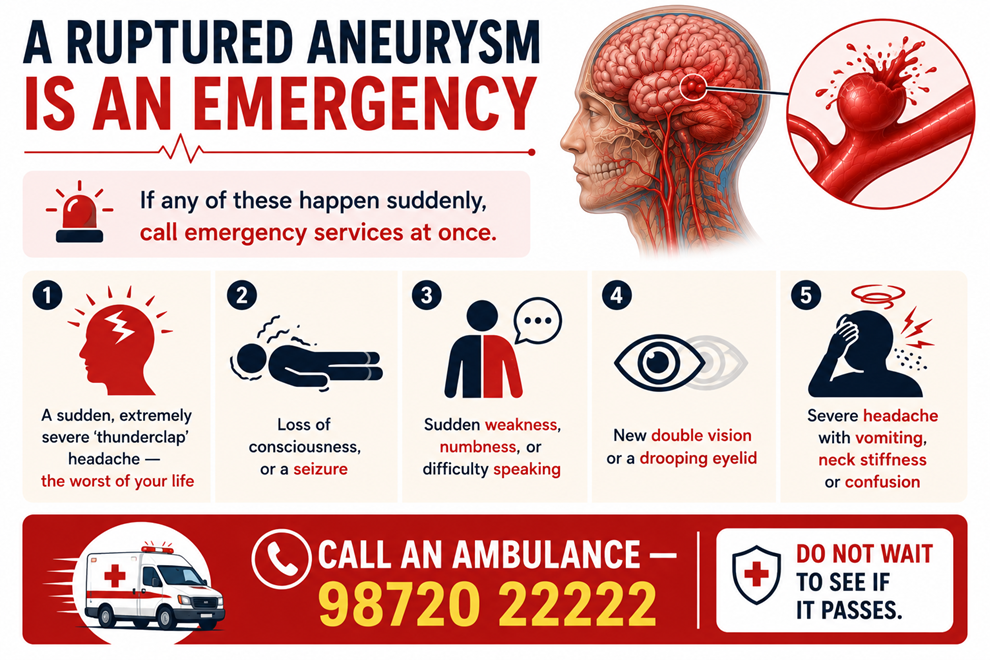
These symptoms may indicate rupture and need urgent assessment. Ordinary or recurring headaches are common and usually not caused by an aneurysm — the pattern that demands emergency care is a sudden, severe, unfamiliar headache, especially with any neurological change.
How is a brain aneurysm treated?
Treatment no longer always means opening the skull. As with the other neurovascular procedures in this series, the specialist can reach selected aneurysms by guiding slender catheters through an artery — usually starting at the wrist or groin — and navigating to the brain under X-ray guidance. These endovascular techniques aim either to close the aneurysm from within, or to redirect blood away from it while keeping the normal artery open.
Open surgery still has an important role. In surgical clipping, a small metal clip is placed across the aneurysm’s neck. It is effective, but it involves opening the skull. The landmark ISAT trial helped establish that, for many suitable ruptured aneurysms, endovascular coiling can be a good alternative to clipping — which is part of why minimally invasive treatment has grown so much. The best choice still depends on the individual aneurysm and patient.
Coiling: filling the danger zone
In coiling, a very fine microcatheter is guided into the aneurysm sac, and soft platinum coils — thinner than a hair — are packed inside. The coils slow the blood swirling in the bulge and encourage it to clot, sealing the aneurysm off while keeping the main artery and its branches open.
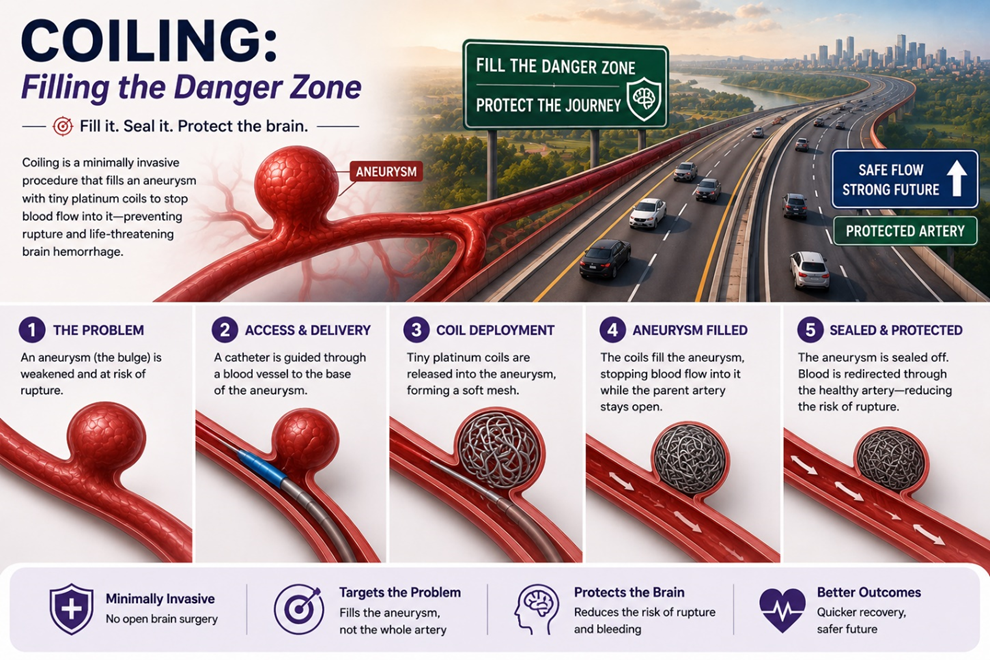
Coiling may be considered for certain ruptured aneurysms, for saccular ("berry-shaped") aneurysms with suitable anatomy, and when an endovascular approach is preferable to surgery. Wide-necked aneurysms may need a balloon or a supporting stent to keep the coils in place. It is minimally invasive and treats the sac directly — but coils can occasionally compact or an aneurysm can reopen over time, so follow-up imaging matters, and a few aneurysms are better suited to another technique or to surgery.
Flow diverters: rebuilding the highway
Coiling treats the bulge itself. A flow diverter treats the artery the bulge came from. It is a fine mesh tube placed across the aneurysm’s opening inside the parent artery. It redirects blood along the normal vessel, reduces the flow entering the aneurysm, and provides a scaffold over which the artery’s own inner lining gradually grows — effectively rebuilding the vessel wall.
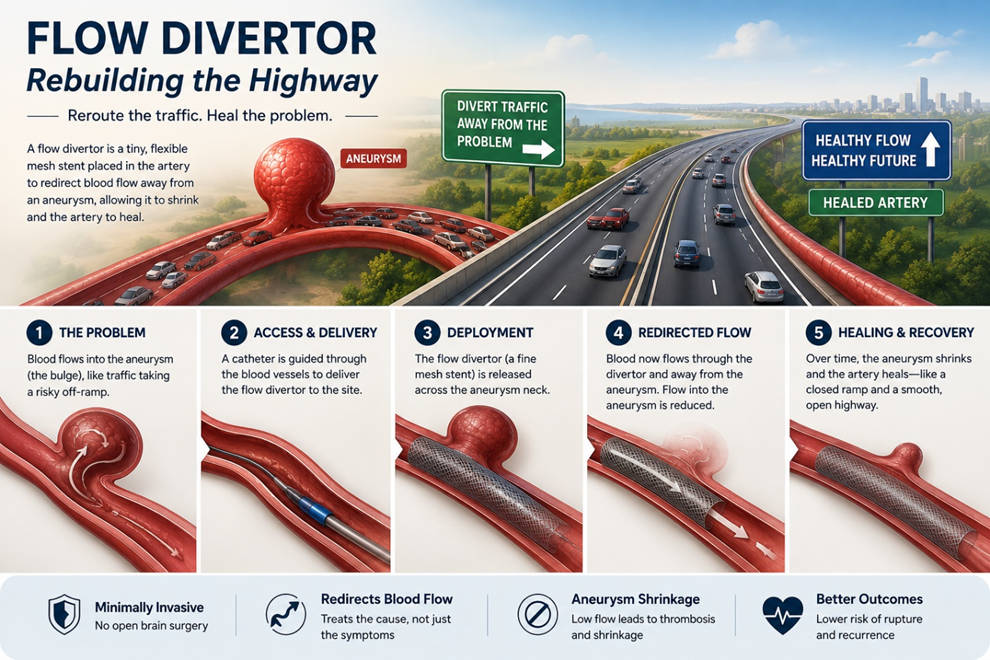
Flow diverters can be game-changers for wide-neck, large, giant, fusiform or recurrent aneurysms that are hard to secure with coils alone. But healing is gradual — the aneurysm is not sealed instantly, so follow-up imaging is essential and the prescribed antiplatelet medicines must be taken exactly as directed. Flow diversion also carries device-specific risks, including clot formation, stroke, narrowing of the artery, and rarely a delayed bleed, so patient selection is careful.
Coiling vs flow diversion: a simple comparison
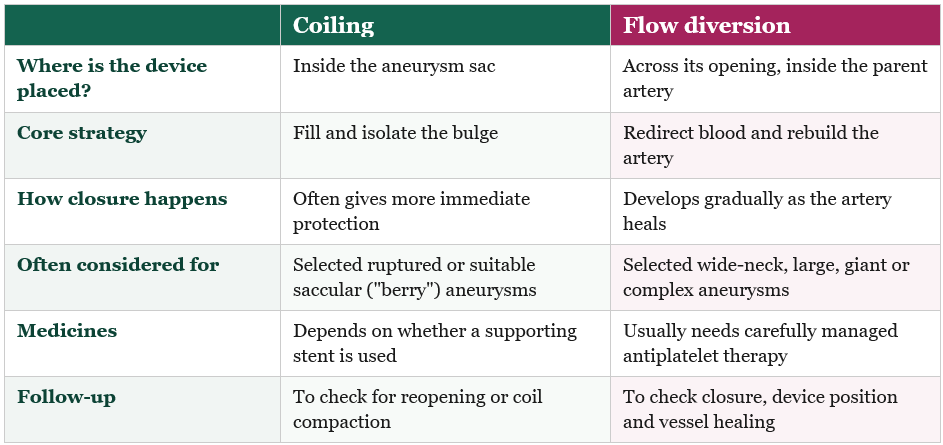
Neither technique is universally "better." A 2026 randomized comparison of mostly smaller, unruptured wide-neck ophthalmic aneurysms did not find flow diversion superior to coiling, while flow diverters have an established role in large, giant and complex aneurysms where coiling alone struggles — at the cost of some device-specific risk. The patient group and the aneurysm’s anatomy matter enormously.
It is not just the size — it is the whole risk profile
When deciding whether and how to treat, the neurovascular team weighs many factors together: whether the aneurysm has ruptured; its size and any growth; its shape, neck width and wall irregularity; its location and nearby branches; any previous bleeding or treatment; symptoms; your age and overall health; smoking and blood-pressure history; and family history or inherited conditions — always balancing the expected benefit against the risk of the procedure.
“The right question is not simply, ‘Do I have an aneurysm?’ It is, ‘What is the safest strategy for this particular aneurysm, in this particular person?’”
Life after treatment
Recovery depends on whether the aneurysm had ruptured and on how complex the treatment was. Many people who have a planned, preventive procedure are up and about quickly and home within a day or two. A few points matter for everyone:
- Follow-up imaging — CT angiography, MR angiography or catheter angiography — is standard, to confirm the aneurysm is sealed and the vessel is healing.
- Do not stop antiplatelet medicines on your own after a stent or flow diverter — this can be dangerous.
- Blood-pressure control and stopping smoking are important parts of protecting your arteries.
- Any new, severe headache or neurological symptom after treatment needs urgent medical assessment.
Finding aneurysms early — and who is at higher risk
Because most aneurysms are silent, they are often found on a brain scan done for another reason. When there is a specific concern, painless, non-invasive scans — MR angiography (MRA) or CT angiography (CTA) — can look for them. Routine scanning of everyone is not the answer, but some people are at higher risk:
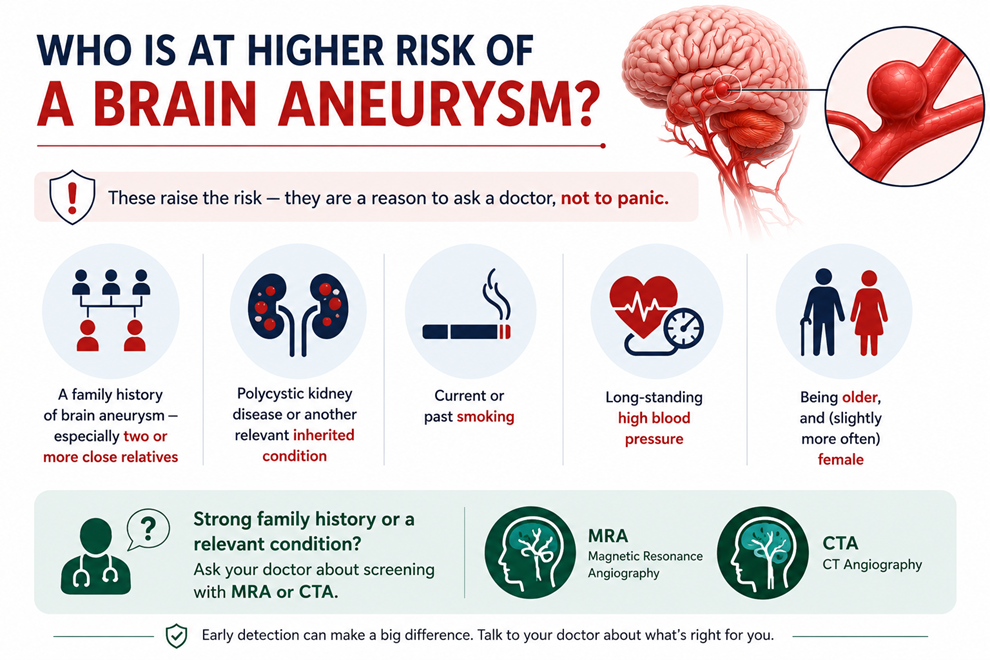
If you have a strong family history of brain aneurysm — particularly two or more affected close relatives — or an inherited condition such as polycystic kidney disease, it is worth asking your doctor whether screening is right for you. The goal is timely, sensible evaluation, not anxiety.
Why Fortis Hospital, Mohali
Aneurysm treatment is precise work performed close to the brain, and it benefits from the right equipment and an experienced team. Fortis Mohali brings together a multidisciplinary neurovascular team and a bi-plane cath lab — the only one in a private hospital north of Delhi — which captures two X-ray views at once for greater precision and less contrast dye during delicate procedures such as coiling and flow diversion. This service is available 24×7 for patients across Mohali, Chandigarh, Panchkula and the wider tricity.
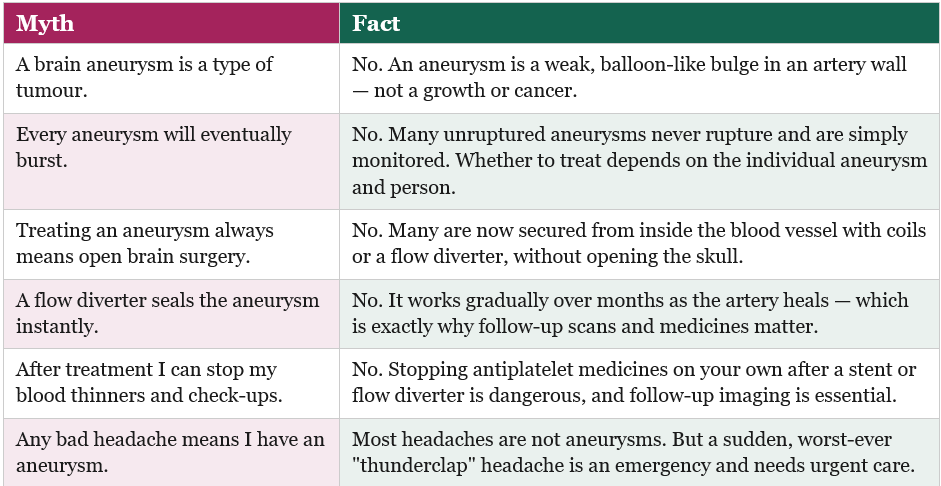
Myth vs Fact
The right next step
About the Author
Prof (Dr) Vivek Gupta
Director, Interventional Neuroradiology, Fortis Hospital, Mohali
Prof (Dr) Vivek Gupta is a senior interventional neuroradiologist with over 20 years of experience in stroke intervention, brain-aneurysm treatment (coiling and flow diversion), and complex neurovascular procedures. At Fortis Mohali he leads a 24×7 neurovascular service equipped with a bi-plane cath lab — the only one in a private hospital north of Delhi.
Categories
Clear allMeet the doctor

- Neurointerventional Radiology | Neurointerventional Radiology
- Radiology | Interventional Radiology
-
 10 Years
-
 1050
1050
Related Blogs
View all

Non-Surgical Treatment For Uterine Fibroid

Stenting for Carotid Artery Disease : Why you need a Second opinion in Mohali

Neurovascular and Neurointerventional Radiology Hospital in Mumbai
Tingling Numbness or a Mini-Stroke? When Carotid Artery Disease Needs Attention

FAQs
Do all brain aneurysms need treatment?
No. Many unruptured aneurysms are simply monitored. The decision to observe, treat with medicines and risk-factor control, or secure the aneurysm depends on its size, shape, location and rupture status, and on your overall health.
What does a ruptured aneurysm feel like?
Often a sudden, extremely severe "thunderclap" headache — the worst of your life — sometimes with loss of consciousness, vomiting, neck stiffness or a seizure. This is an emergency; call for help immediately.
Is coiling or a flow diverter better?
Neither is universally better. Coiling fills the aneurysm sac; a flow diverter rebuilds the artery across its opening. The right choice depends on the aneurysm’s size, shape and location, and on the person — which is why an experienced team decides case by case.
Will I need open brain surgery?
Often not. Many aneurysms are treated from inside the blood vessel, without opening the skull. Some aneurysms are still best treated with surgical clipping — your team will advise.
Why are blood thinners needed after a flow diverter?
A flow diverter and stents are metal devices, and antiplatelet medicines prevent clots forming on them. They must be taken exactly as prescribed and never stopped on your own.
A close relative had a brain aneurysm — should I be screened?
Possibly. A strong family history (especially two or more affected close relatives) or certain inherited conditions may make screening with MRA or CTA worthwhile. Ask your doctor whether it is right for you.

Keep track of your appointments, get updates & more!

