


Are You a Carrier? Why Pre-Conception Genetic Screening Matters Before Your Next Pregnancy
By Dr Ravneet Kaur Consultant, Medical Genetics & Genomic Medicine | Fortis Hospital, Mohali DM Medical Genetics (AIIMS, New Delhi) | Fortis Institute of Genomic Medicine
Healthy Parents. Hidden Risks.
“We have no family history.” This is one of the most common statements I hear in my genetics clinic. And it is also one of the most misleading — because most carriers of genetic conditions are completely healthy, have no symptoms, and have no affected family members. The condition stays hidden for generations, until two carriers meet and have a child together. By then, the first sign of the condition is not a test result — it is an affected baby, or in some cases, a pregnancy that ends in loss.
Carrier screening is a simple blood or saliva test that can identify whether you carry a genetic variant for an inherited condition — before you become pregnant, before a problem arises, and before your options narrow. It is especially relevant for couples planning pregnancy, undergoing IVF, or trying again after a previous unexplained pregnancy loss.
What Is Pre-Conception Genetic Carrier Screening?
Carrier screening checks whether you carry a gene variant for a recessive or X-linked inherited condition. It is different from NIPT (which screens an existing pregnancy for chromosomal conditions). Carrier screening is ideally done before conception, so that couples have the widest range of reproductive options if a risk is identified.
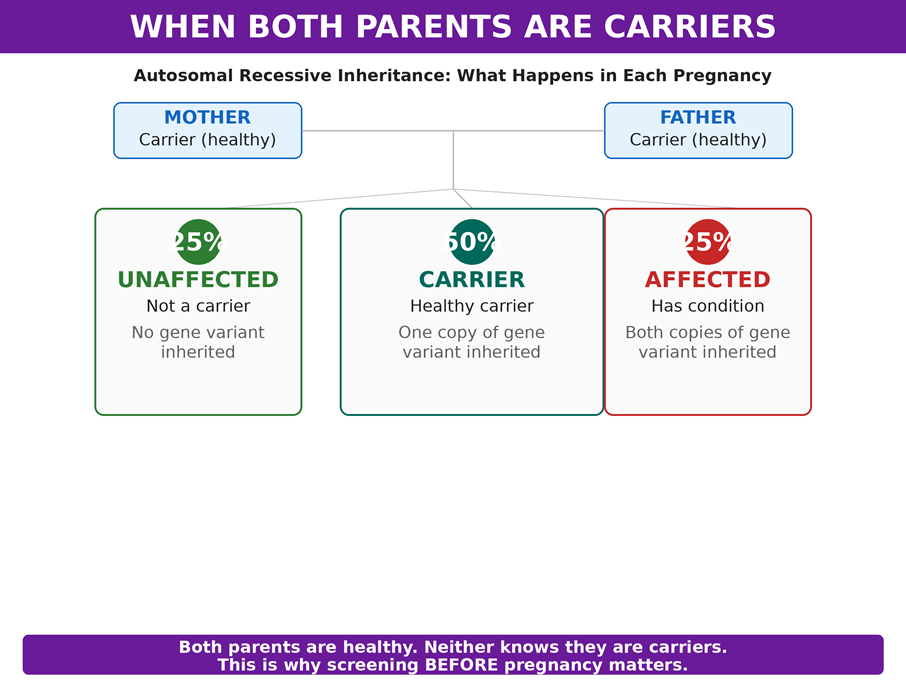
A carrier is someone who has one working copy and one non-working copy of a gene. They are healthy because one working copy is enough. But if both parents are carriers of the same condition, each pregnancy carries a 1 in 4 (25%) chance of producing a child with the full condition — and a 50% chance that the child will be a carrier like the parents.
What Conditions Can Be Detected?
Modern expanded carrier panels screen for 100–500+ inherited conditions in a single test. The most clinically important conditions include those that are common, severe, and have well-characterised genetic variants.
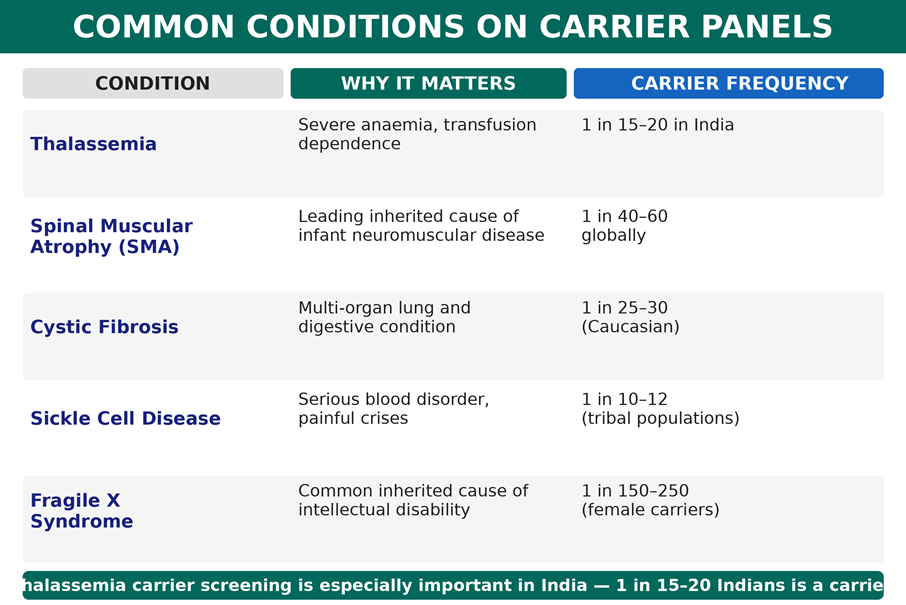
In India, beta-thalassemia is the most relevant condition for universal carrier screening. An estimated 3.5 crore Indians are thalassemia carriers. Most do not know. Two carriers together face a 25% risk of having a child with thalassemia major — a condition requiring lifelong blood transfusions and chelation therapy. A simple blood test before pregnancy can identify this risk.
Who Should Consider Carrier Screening?
ACOG (American College of Obstetricians and Gynecologists) and ACMG (American College of Medical Genetics) now recommend offering carrier screening to all individuals planning pregnancy, regardless of ethnicity or family history. This is a significant shift from older guidelines that recommended screening only for “high-risk” groups.
Screening is particularly important for:
- All couples planning pregnancy — most carriers have no family history
- Couples with consanguineous marriage (marriage between relatives) — significantly higher chance of shared carrier status
- Couples undergoing IVF or assisted reproduction — carrier screening can be combined with preimplantation genetic testing (PGT-M)
- Couples with a family history of any inherited condition
- Couples where one partner is already known to be a carrier
- Couples from communities with known high carrier frequencies — thalassemia (India), sickle cell (tribal populations), Tay-Sachs (Ashkenazi Jewish)
Previous Unexplained Miscarriage? Carrier Screening May Provide Answers
This is a section that many couples reading this blog will find personally relevant. If you have experienced one or more unexplained pregnancy losses, you have likely been told “it is common” or “it was just bad luck.” And in many cases, that is true — 50–70% of early miscarriages are caused by random chromosomal abnormalities in the pregnancy that are not inherited and do not recur.
However, after two or more unexplained losses, genetic evaluation becomes important. Here is why:
Carrier Status and Pregnancy Loss
If both parents carry the same recessive condition, 25% of pregnancies will be affected. Some of these affected pregnancies — particularly those involving severe metabolic or structural conditions — may end in early miscarriage rather than progressing to term. The couple experiences “unexplained loss” without ever knowing that a specific inherited condition was the cause. Up to 5–10% of couples with recurrent pregnancy loss are found to carry a recessive condition that contributed to their losses.
Balanced Chromosomal Rearrangements
Carrier screening for gene-level conditions is separate from chromosomal analysis. A parent may carry a balanced translocation — a rearrangement of chromosomal material that has no effect on the parent’s health but produces embryos with unbalanced chromosomes, leading to repeated miscarriage. If you have had two or more unexplained losses, your geneticist may recommend both expanded carrier screening AND a parental karyotype to check for translocations.
What Carrier Screening Cannot Explain
Carrier screening does not detect all causes of miscarriage. Uterine anomalies, hormonal imbalances, thrombophilias, immunological factors, and random chromosomal errors in the embryo are not covered by carrier screening. A complete recurrent pregnancy loss evaluation may involve additional tests beyond carrier screening.
If you have experienced two or more unexplained miscarriages, ask your doctor for both: (1) expanded carrier screening to check for inherited gene-level conditions, and (2) a parental karyotype to rule out balanced chromosomal rearrangements. Together, these tests cover two of the most important genetic causes of recurrent loss.
What If Both Partners Are Carriers?
Finding out that both you and your partner are carriers of the same condition is not the end of the road. It is the beginning of informed decision-making. The goal of carrier screening is not to prevent pregnancy. It is to ensure that couples understand their specific risks and have access to every available option.
- Natural conception with prenatal testing — CVS (10–13 weeks) or amniocentesis (15+ weeks) can definitively diagnose or rule out the condition during pregnancy
- IVF with preimplantation genetic testing (PGT-M) — embryos are tested for the specific condition before transfer, allowing only unaffected embryos to be used
- Donor gametes — using donor sperm or donor eggs that do not carry the same variant
- Continuing pregnancy with preparation — for treatable conditions, early diagnosis allows early intervention
A genetic counsellor will walk you through each option in detail, helping you understand the practical steps, timelines, success rates, and emotional considerations for your specific situation.
From the Practice
A couple from Ludhiana came to my clinic after three unexplained miscarriages over two years. Both were healthy. Both had normal fertility workups. Both had been told “it’s just bad luck.” Expanded carrier screening revealed that both partners were carriers of a rare autosomal recessive metabolic condition. Each of their pregnancies had a 25% chance of being affected — and the affected embryos were not surviving past the first trimester. With this knowledge, they chose IVF with preimplantation genetic testing (PGT-M). Only unaffected embryos were transferred. Their fourth pregnancy — their first with PGT-M — went to full term. They now have a healthy daughter. The answer to three years of heartbreak was a blood test that could have been done before the first pregnancy.
Common Myths About Carrier Screening
Myth: “We don’t have a family history, so we don’t need screening.”
Most carriers have no affected family members. Carrier status can remain hidden for generations until two carriers have a child together.
Myth: “We are healthy, so our baby will be healthy.”
Carriers are by definition healthy. The risk arises only when both parents carry the same condition — and this is invisible without testing.
Myth: “Carrier screening is only for high-risk couples.”
ACOG and ACMG now recommend offering carrier screening to all couples planning pregnancy, regardless of ethnicity or family history.
Myth: “If I’m a carrier, it means I have the disease.”
A positive carrier result means you carry one copy of a gene variant. You do not have the disease and will never develop it. The concern is only if your partner carries the same condition.
Knowing your carrier status before pregnancy can help you plan with confidence — especially when a previous loss has left more questions than answers. Schedule a genetic counselling consultation with Dr Ravneet Kaur at the Fortis Institute of Genomic Medicine, Fortis Hospital Mohali. Whether you are planning your first pregnancy or trying again after a loss, a simple test can provide the clarity you need.
About the Author
Dr Ravneet Kaur is a Consultant in Medical Genetics and Genomic Medicine at Fortis Hospital, Mohali. She completed her DM in Medical Genetics from AIIMS, New Delhi. Dr Kaur leads the Fortis Institute of Genomic Medicine, providing genetic counselling, carrier screening, prenatal genetic diagnosis, cancer genomics, and precision medicine support. Her clinical focus includes pre-conception carrier screening, recurrent pregnancy loss evaluation, genetic counselling for consanguineous couples, and coordination with reproductive medicine teams for IVF with preimplantation genetic testing (PGT-M). She works closely with the Departments of Obstetrics, Fetal Medicine, and Reproductive Medicine to ensure that genetic risks are identified and managed at the earliest possible stage.
Categories
Clear allMeet the doctor

- Paediatrics | Paediatrics
- Medical Genetics | Medical Genetics
-
 9 Years
-
 1500
1500
Related Blogs
View all
Unraveling the power of genes: A lot more than how you look

Breakthrough Discoveries in Genetic Research: Unlocking the Secrets of DNA and Heredity

CHIP Mutations in Hematology: The Silent Forecasters of Risk

Genomics in Hematology: Redefining Diagnosis and Therapy at Fortis Institute of Genomic Me...
Decoding the Mystery of Rare Diseases: A Family’s Guide to Medical Genetics



FAQs
Can carrier screening explain my miscarriage?
In some cases, yes. If both partners are carriers of the same severe condition, affected embryos may miscarry rather than survive to term. However, carrier screening does not explain all miscarriages — random chromosomal errors, uterine factors, and other causes must also be evaluated.
Is carrier screening the same as NIPT?
No. NIPT screens an existing pregnancy for chromosomal conditions (like Down syndrome). Carrier screening tests the parents for inherited gene-level conditions. Ideally, carrier screening is done before pregnancy; NIPT is done during pregnancy.
Should both partners be tested?
Ideally, yes. One partner can be tested first. If that partner is a carrier for a specific condition, the other partner is tested for the same condition. Some couples choose to test both simultaneously.
What if my screening is negative?
A negative result greatly reduces — but does not eliminate — the risk. Expanded panels cover 100–500+ conditions, but not every possible genetic variant. A normal result is reassuring, not a guarantee.
Can I do carrier screening during pregnancy?
Yes, but pre-conception is ideal because it provides more time and more options. During pregnancy, if both partners are found to be carriers, confirmatory prenatal testing (CVS or amniocentesis) can still be performed, but the timeline is tighter.
Does one miscarriage mean I need genetic testing?
A single miscarriage is very common and usually does not require genetic evaluation. After two or more unexplained losses, genetic testing — including carrier screening and parental karyotype — is generally recommended.

Keep track of your appointments, get updates & more!

