


Why NIPT Matters in Your Pregnancy The Simple Blood Test That Gives You Answers from 10 Weeks
A Geneticist’s Guide to Non-Invasive Prenatal Testing
By Dr Ravneet Kaur Associate Consultant, Medical Genetics | Fortis Hospital, Mohali MBBS | MD (Paediatrics) | DM (Medical Genetics), AIIMS New Delhi Former Assistant Professor, PGIRML Hospital, New Delhi | 10+ publications | 4 book chapters
In consultation with Dr Divya Awasthi Additional Director, Obstetrics & Gynaecology | Fortis Hospital, Mohali
Every Parent Hopes for a Healthy Baby
“What if there was a safe, simple blood test from as early as 10 weeks that could screen for common chromosomal conditions with over 99 percent accuracy—without any risk to your baby? That test exists. It is called NIPT, and as a medical geneticist, I believe every expecting parent deserves to know about it.”
Every pregnancy brings a beautiful mix of excitement and anxiety. One of the most common worries expectant parents carry is whether their baby is developing normally. For decades, getting detailed genetic information meant either accepting the limitations of conventional screening or undergoing an invasive procedure that carried a small but real risk of miscarriage.
Non-Invasive Prenatal Testing (NIPT) has fundamentally changed this equation. It is a blood test—taken from the mother’s arm, just like any routine blood draw—that analyses tiny fragments of the baby’s DNA circulating in the mother’s blood. From this single sample, we can screen for the most common chromosomal conditions with remarkable accuracy, at zero risk to the baby.
As a medical geneticist specialising in reproductive and prenatal genetics, I have counselled hundreds of couples through the prenatal screening process at Fortis Hospital Mohali. The single most transformative change I have witnessed in this field is NIPT—it replaces weeks of anxious uncertainty with early, reliable information. This guide explains what NIPT is, why it matters, what it can and cannot tell you, and who should consider it.
What Is NIPT and How Does It Work?
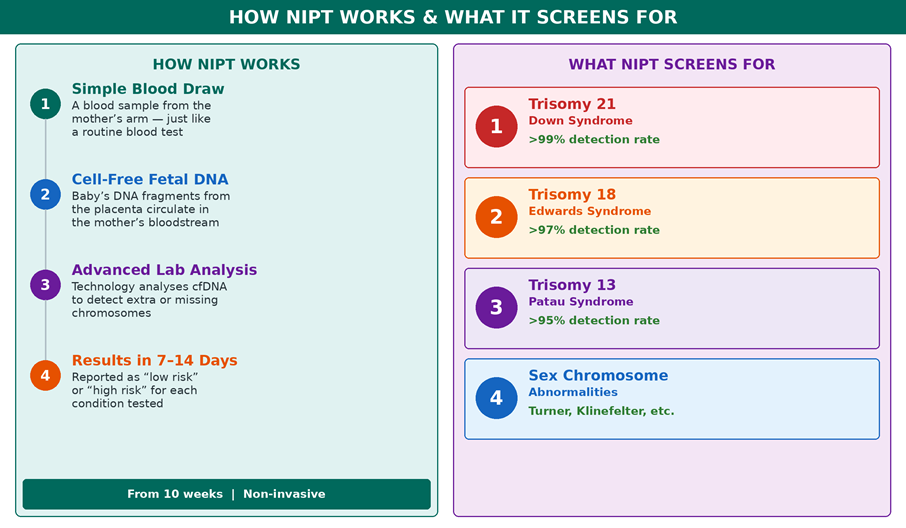
NIPT stands for Non-Invasive Prenatal Testing. During pregnancy, tiny fragments of the baby’s DNA from the placenta—called cell-free fetal DNA (cfDNA)—cross over into the mother’s bloodstream. NIPT captures and analyses this cfDNA to detect whether there are extra or missing chromosomes in the baby.
The test can be performed from 10 weeks of pregnancy onwards, making it one of the earliest screening options available. It requires nothing more than a standard blood draw from the mother’s arm—no needles enter the uterus, no fluid is extracted from around the baby, and there is absolutely zero risk of miscarriage. Results are typically available within 7 to 14 days.
What Does NIPT Screen For?
The core NIPT panel screens for the three most common trisomies: Trisomy 21 (Down syndrome) with over 99 percent detection accuracy, Trisomy 18 (Edwards syndrome), and Trisomy 13 (Patau syndrome). Many panels also screen for sex chromosome abnormalities such as Turner syndrome and Klinefelter syndrome, and some expanded panels can check for specific microdeletion syndromes like DiGeorge syndrome. As your geneticist, I can guide you on which panel is appropriate based on your history and risk profile.
Why NIPT Is a Game-Changer in Prenatal Care
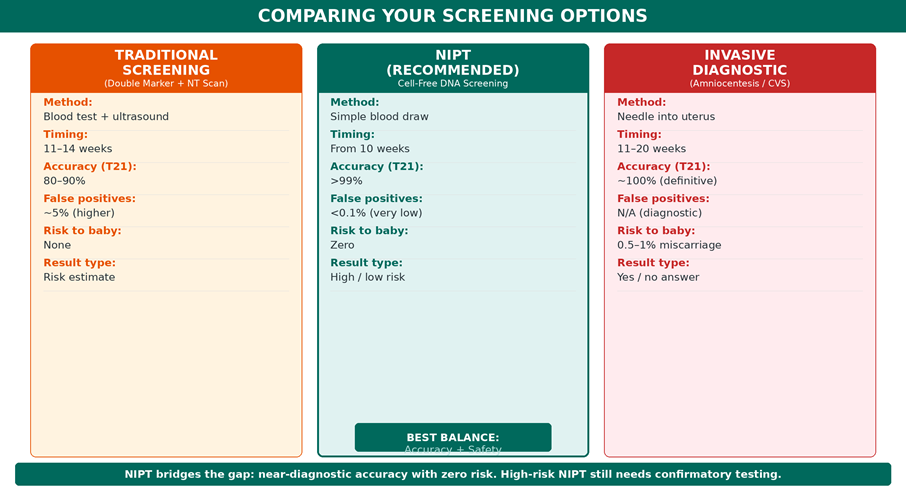
Superior accuracy: NIPT detects Trisomy 21 with over 99 percent sensitivity and specificity—compared to approximately 80 to 90 percent for traditional first-trimester combined screening (the double marker test plus NT scan). The false positive rate is dramatically lower: less than 0.1 percent for NIPT versus approximately 5 percent for conventional screening. This means far fewer women are subjected to unnecessary anxiety or invasive follow-up testing.
Complete safety: Unlike amniocentesis or chorionic villus sampling (CVS), which require inserting a needle into the uterus and carry a 0.5 to 1 percent risk of miscarriage, NIPT is just a blood draw. No physical contact with the baby, no procedural risk whatsoever.
Earlier reassurance: Because NIPT can be done from 10 weeks, parents receive critical information in the first trimester—earlier than most conventional screening pathways. This allows more time for informed decision-making, planning, and if needed, further evaluation.
Fewer unnecessary invasive procedures: Studies show that NIPT adoption has led to a 50 to 75 percent reduction in amniocentesis and CVS procedures. When NIPT shows low risk, the vast majority of women can avoid invasive testing altogether.
The Most Important Distinction: NIPT Is a Screening Test
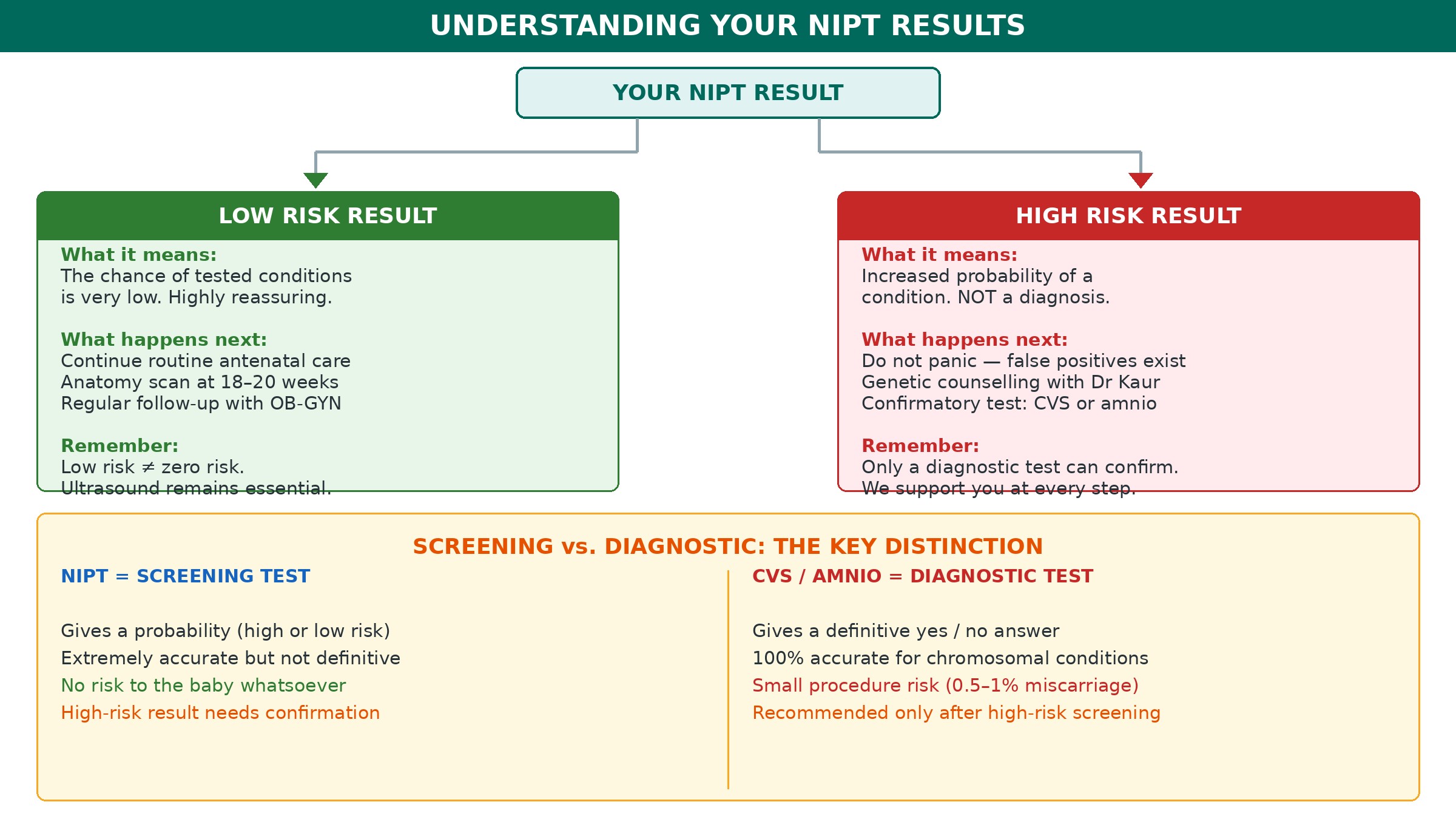
This is the single most critical point I emphasise with every patient I counsel: NIPT is a screening test, not a diagnostic test. It tells you the probability—high risk or low risk—of a specific chromosomal condition. It does not give a definitive yes-or-no answer. Understanding this distinction is essential for interpreting your results correctly.
A low-risk result is highly reassuring. It means the chance of the tested conditions is very low—but not zero. Routine antenatal care, including the detailed anatomy ultrasound at 18 to 20 weeks, should continue as planned. NIPT does not screen for all genetic conditions or structural birth defects, so ultrasound remains an irreplaceable part of prenatal care.
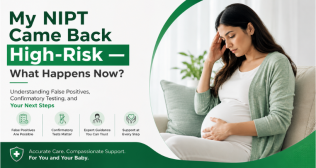
A high-risk result does not mean your baby definitely has the condition. False positives, while rare, can occur—sometimes due to confined placental mosaicism or low fetal fraction. A high-risk NIPT result must always be confirmed through a diagnostic procedure (CVS or amniocentesis) before any clinical decision is made.
This is precisely where a medical geneticist adds the most value. Pre-test counselling helps you understand what NIPT can and cannot tell you before the blood is drawn. Post-test counselling—especially for high-risk results—ensures you understand the findings, the next steps, and all available options, so no decision is made in confusion or panic.
Who Should Consider NIPT?
Current guidelines from the American College of Obstetricians and Gynecologists (ACOG) state that cell-free DNA screening should be discussed with and offered to all pregnant patients, regardless of age or risk level. Any pregnancy can be affected by a chromosomal abnormality, and NIPT provides the most accurate non-invasive screening currently available.
That said, NIPT is especially valuable for certain groups:
Women aged 35 or older at delivery — the risk of trisomies increases with maternal age, making high-accuracy screening particularly important.
Abnormal first-trimester screening results — NIPT can clarify risk without immediately proceeding to an invasive test.
Previous pregnancy or child with a chromosomal condition — parents naturally want the most accurate reassurance available.
Ultrasound findings that raise concern — soft markers or structural findings that increase the pre-test probability.
IVF pregnancies — where the emotional and financial investment heightens the desire for early clarity.
Any expecting parent who wants the highest level of screening reassurance — even younger, average-risk mothers who simply want peace of mind.
What NIPT Cannot Tell You
Transparency about limitations is just as important as explaining benefits—and this is where genetic counselling makes a real difference. NIPT does not screen for all genetic diseases—conditions like cystic fibrosis, sickle cell disease, or single-gene disorders require different tests. It does not detect structural birth defects such as heart malformations or neural tube defects—this is why the detailed anatomy ultrasound at 18 to 20 weeks remains irreplaceable. And it does not replace routine antenatal monitoring.
NIPT is one powerful tool within a comprehensive prenatal care strategy—not a standalone replacement for everything else. This is also why the collaboration between your geneticist and your obstetrician matters: we integrate NIPT results with ultrasound findings, clinical history, and family history to give you the most complete picture possible.
From Your Obstetrician’s Chair: Dr Divya Awasthi
“As an obstetrician managing high-risk pregnancies at Fortis Mohali, I see NIPT as one of the most significant advances in prenatal care. It gives me and my patients early, reliable information that shapes how we plan the pregnancy going forward. When a low-risk NIPT result comes back, the relief on a mother’s face is immediate—and when a high-risk result appears, having Dr Ravneet Kaur’s genetic counselling expertise alongside us makes all the difference. The combination of NIPT with our advanced fetal medicine services—including 3D ultrasound, anomaly scans, and multidisciplinary support—means families at Fortis Mohali have access to the most comprehensive prenatal evaluation available in the region.”
— Dr Divya Awasthi, Additional Director, Obstetrics & Gynaecology, Fortis Hospital Mohali
Knowledge Brings Peace. Early Screening Brings Clarity.
“Good prenatal screening is not just about detecting risk—it is about helping parents make informed, calm decisions. In my experience, the couples who do best are those who have the right information at the right time, with the right support. That is exactly what NIPT, combined with genetic counselling, provides.” — Dr Ravneet Kaur
If you are pregnant or planning a pregnancy, I encourage you to discuss NIPT with your obstetrician or geneticist early in your antenatal care. Understanding your options—and choosing the right screening for your situation—is one of the most empowering steps you can take for your family.
To schedule a genetic counselling consultation with Dr Ravneet Kaur or a prenatal appointment with Dr Divya Awasthi at Fortis Hospital Mohali, contact the Institute of Genomic Medicine or the Department of Obstetrics & Gynaecology. Please bring any previous reports, ultrasound scans, and family history details for personalised guidance.
About the Authors
Dr Ravneet Kaur is an Associate Consultant in Medical Genetics at Fortis Hospital, Mohali, and a key member of the Fortis Institute of Genomic Medicine. She holds an MBBS, MD (Paediatrics), and DM in Medical Genetics from AIIMS, New Delhi. Her senior residency training at GMCH-32, Chandigarh, and VMMC & Safdarjung Hospital, New Delhi, was followed by a faculty position as Assistant Professor at PGIRML Hospital, New Delhi. Driven by a passion for rare diseases, she specialises in reproductive genetics (including infertility and recurrent pregnancy losses), pre-conceptional and prenatal genetic counselling, and the diagnosis and management of paediatric genetic disorders. She has authored over 10 publications in indexed journals and 4 book chapters.
Dr Divya Awasthi is the Additional Director, Obstetrics & Gynaecology at Fortis Hospital, Mohali. She completed her MS (OBG) from IMS BHU Varanasi, followed by a senior residency at AIIMS New Delhi. She received specialised training in Gynecologic Oncology at Tata Memorial Hospital, Mumbai, and completed an Assisted Reproductive Technology course by the Cleveland Clinic, USA. With over 15 years of experience, she provides comprehensive care for high-risk pregnancies, prenatal screening, infertility, and gynaecological oncology across the Chandigarh–Mohali–Panchkula tricity, Punjab, Haryana, and Himachal Pradesh.
Contact Us – Fortis Hospital Mohali
For appointments, consultations, and diagnostic services, please contact:
📞 72728 72728
Our care team will assist you with:
Doctor appointments
Diagnostic and screening services
Health check-ups
Call now to book your appointment at Fortis Hospital, Mohali.
Categories
Clear allMeet the doctor

- Medical Genetics | Medical Genetics
- Paediatrics | Paediatrics
-
 9 Years
-
 1500
1500
Related Blogs
View all
Unraveling the power of genes: A lot more than how you look

Breakthrough Discoveries in Genetic Research: Unlocking the Secrets of DNA and Heredity

CHIP Mutations in Hematology: The Silent Forecasters of Risk

Genomics in Hematology: Redefining Diagnosis and Therapy at Fortis Institute of Genomic Me...
Decoding the Mystery of Rare Diseases: A Family’s Guide to Medical Genetics
FAQs
Is NIPT safe for my baby?
Completely. NIPT involves only a blood draw from the mother’s arm. There is no needle near the baby, no contact with the uterus, and zero risk of miscarriage.
How accurate is NIPT for Down syndrome?
NIPT detects Trisomy 21 with over 99 percent sensitivity and specificity. It is the most accurate non-invasive screening test available for common fetal aneuploidies. However, it remains a screening test—high-risk results should be confirmed with diagnostic testing.
What happens if my NIPT result is high-risk?
Do not panic. A high-risk result means there is an increased probability, not a certainty. Dr Ravneet Kaur provides expert genetic counselling to explain the results and discuss next steps, which typically include a confirmatory diagnostic test such as CVS or amniocentesis.
Is NIPT only for older mothers?
No. While it is especially valuable for women over 35, ACOG recommends that NIPT be discussed with and offered to all pregnant women regardless of age. Chromosomal conditions can occur in any pregnancy.
Do I still need an ultrasound after NIPT?
Absolutely. NIPT screens for chromosomal conditions, but it does not evaluate the baby’s physical structure. The anatomy ultrasound at 18 to 20 weeks is essential for detecting structural abnormalities that NIPT cannot identify.
Why should a geneticist be involved in NIPT counselling?
A medical geneticist specialises in understanding genetic test results, their implications, and the options available. Pre-test counselling ensures you understand what NIPT can and cannot tell you. Post-test counselling—especially for high-risk results—ensures decisions are informed, supported, and never made in isolation.

Keep track of your appointments, get updates & more!

