


Family History of Cancer? What to Do Next - Genetic Counselling Guide
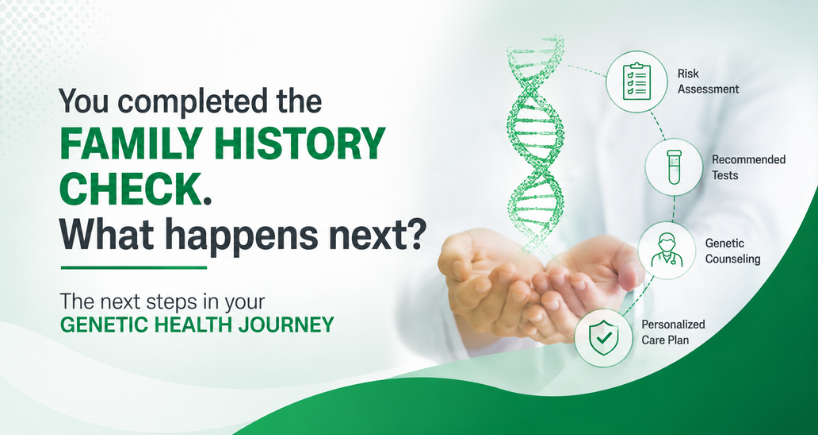
You completed the family history check. What happens next?
Whether you ticked “Yes” once or several times, you’ve just taken a proactive step for your health and your family’s. Here’s the most important thing to hold onto: identifying a possible risk is not a diagnosis — it’s a roadmap. Your family history doesn’t have to be your destiny.
By Dr Ravneet Kaur — DM Medical Genetics (AIIMS) · Consultant, Medical Genetics, Fortis Cancer Institute
Completing a checklist about cancer in your family can stir up a mix of feelings — curiosity, relief, or quiet worry. All of that is normal. This guide is here to help you make sense of what your answers mean, no matter how many boxes you ticked.
Start with the big picture. Most cancers are not inherited — roughly 90–95% happen by chance, driven by ageing, environment, lifestyle, and the random changes that build up in our cells over a lifetime. Only about 5–10% of cancers are hereditary, caused by a single gene change passed down a family. The checklist you completed was designed to spot the patterns that hint at that smaller, important group — so the right people can get the right advice at the right time.
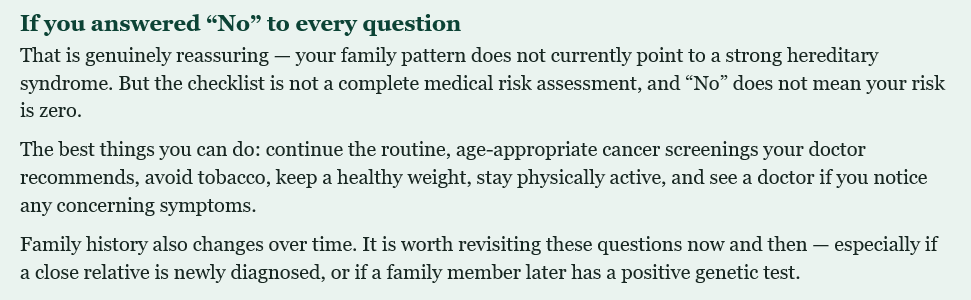
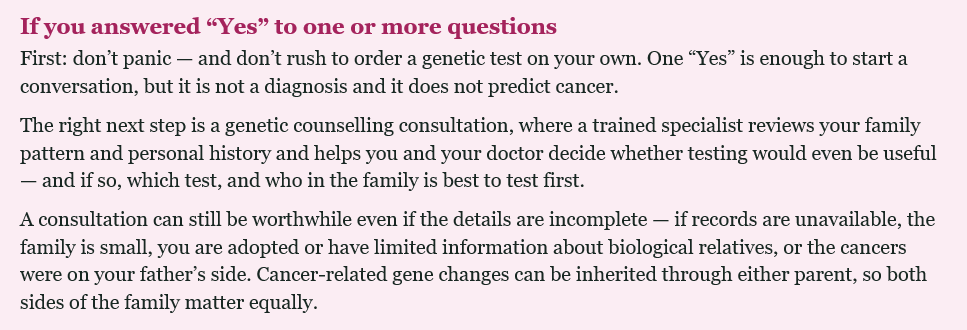
The questionnaire is a conversation starter, not a diagnosis. A “Yes” doesn’t confirm anything — and a “No” doesn’t guarantee zero risk.
What your answers mean
The patterns the checklist looked for
The questions were not random — each one is a recognised red flag that raises the chance of an inherited cause. Here is what they were checking for.
Your red-flag recap
There is no score to be afraid of — this simply shows what makes a conversation worthwhile.
❑ Any cancer diagnosed before age 50 in you or a close blood relative
❑ Two or more relatives on the same side with the same or related cancers
❑ One person who has had two or more different cancers
❑ Ovarian, fallopian tube or peritoneal cancer — at any age
❑ Breast cancer before 45, in both breasts, triple-negative, or in a man
❑ Colon or uterine cancer, especially before age 50, or many bowel polyps
❑ Pancreatic cancer, or advanced prostate cancer, in the family
❑ Cancer across three or more generations
❑ A known cancer gene change already found in a relative (BRCA1, BRCA2, Lynch, TP53)
When these patterns appear — especially together — they raise the possibility that a single gene variant is being passed through the family.
Why this matters even if you already have cancer
Genetic assessment is not only for healthy relatives. If you are living with a cancer diagnosis, a gene result can matter right now, in three ways.
1. It can change your treatment. For some cancers, a hereditary gene change opens a specific door. Cancers linked to BRCA1 or BRCA2 — and related DNA-repair faults — can respond to targeted drugs called PARP inhibitors, now used in certain breast, ovarian, prostate and pancreatic cancers. Cancers with a Lynch-syndrome-type repair defect can respond especially well to immunotherapy. This is precisely why national guidelines now recommend genetic testing for many cancer patients.
2. It flags your risk of a second, different cancer, so your team can watch the right organs at the right intervals from now on. 3. It protects your family — often the most powerful reason of all.
If you have had breast, ovarian, fallopian tube, pancreatic, colorectal, uterine/endometrial, advanced prostate, or male breast cancer — or more than one separate primary cancer — it is worth asking your treating oncologist whether a genetics consultation is appropriate for you.
The main hereditary cancer syndromes
Most inherited cancer traces back to a small number of well-understood syndromes. You do not need to memorise these — this is simply what the counsellor assesses for. A woman carrying a BRCA change, for example, can have a breast-cancer risk of around 55–70% by age 70 and an ovarian-cancer risk of roughly 17–59%, against about 12% and 1% in the general population.
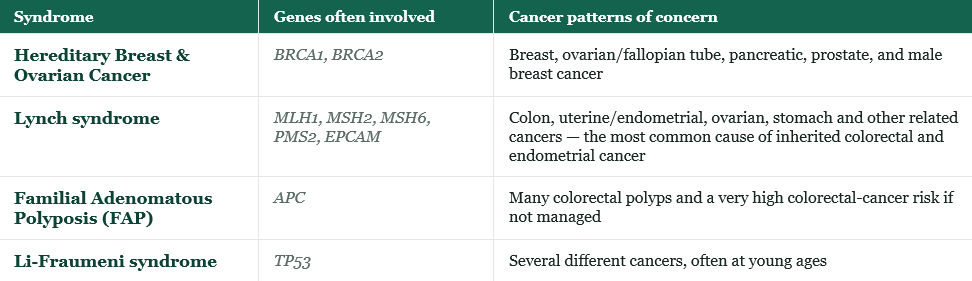
The exact test is chosen only after counselling. Not everyone needs a large panel, and not every family pattern has a detectable inherited cause.
What a genetic counselling session includes
“Genetic counselling” sounds clinical, but it is really a careful conversation — not automatically a blood test. Nothing is tested without your understanding and consent. A session with Dr Ravneet Kaur typically covers:
- A detailed review of your personal and family history, mapped as a three-generation family tree (a “pedigree”).
- A clear assessment of how likely a hereditary syndrome is — for you and for your relatives.
- Whether testing is useful, which test would be appropriate, and who in the family is best to test first.
- Informed consent — the benefits, limits, cost, and what a result could mean for relatives.
- Emotional support: a safe space to talk through fears, privacy concerns, and how results might affect your family. You are never pressured to test.
- Results counselling and a personalised screening or prevention plan, if testing is done.
Why the best person to test is often a relative who has had cancer
Wherever possible, testing begins with a family member who has had the relevant cancer. If a gene change is found in them, everyone else in the family can be offered simpler, focused testing for that exact change — and it gives the clearest answer for the whole family. Testing an unaffected person first can sometimes produce a less informative result, which is exactly why the strategy is decided in counselling rather than by ordering a test blindly.
How to prepare for your appointment
You do not need a perfect family tree — even partial information helps the genetics team spot important patterns. If you can, gather a few details before you come:
- Who had cancer, and how they’re related to you — and whether it was on your mother’s or father’s side.
- The type of cancer each relative had, if known, and their age at diagnosis (an approximate age is fine).
- Any reports you can find — pathology or biopsy reports, discharge summaries, or previous genetic-test results from affected relatives.
- Your own details, if you have cancer — diagnosis, treatment summary, and pathology report.
- Anything unusual — relatives with many polyps, more than one cancer, or preventive (risk-reducing) surgeries.
A consultation can still go ahead if some of this is missing. Bring what you reasonably can.
Understanding the possible results
If you do decide to test, results are not simply “positive” or “negative” — the meaning depends on your family’s situation, and your counsellor will explain yours in context.
A harmful gene change is found (positive)
A disease-causing inherited change has been identified. It does not mean cancer is present today or is inevitable — it means risk is higher than average. It can guide earlier or more frequent screening, risk-reduction options, treatment choices in some cancers, and testing for relatives.
No harmful gene change is found (negative)
Reassuring, but read in context. If the exact change in your family was already known and you don’t carry it, that is especially informative. If no affected relative has been tested, a negative result may not fully explain a strong family history — so screening may still be guided by that history.
A variant of uncertain significance (VUS)
Sometimes testing finds a DNA change whose link to cancer is not yet clear. A VUS is not the same as a confirmed harmful change and usually should not drive major treatment or surgery decisions on its own. Care stays guided by your personal and family history, and many variants are reclassified as science evolves.
While you wait for your appointment
It is completely normal to feel anxious in the meantime. A few things help: talk to relatives to confirm cancer details (accuracy really does matter), try to avoid internet rabbit holes and stick to reputable sources, and remind yourself that “higher risk” does not mean “certain cancer”. Many people who carry a variant never develop cancer, precisely because they are monitored so closely. Consider bringing a partner, parent or close friend to the appointment — a second set of ears helps.
What it means for your family
Inherited cancer genes follow a simple rule: each first-degree relative — a parent, brother, sister, or child — has a 1-in-2 chance of carrying the same change. That single fact is why testing one person can protect a whole family. If a change is found in you, relatives can be offered a simple, targeted test for that exact change — called cascade testing. Those who test positive can begin earlier screening and prevention; those who test negative can be spared unnecessary worry and extra tests. Either way, the knowledge helps — and it is how families break the chain.
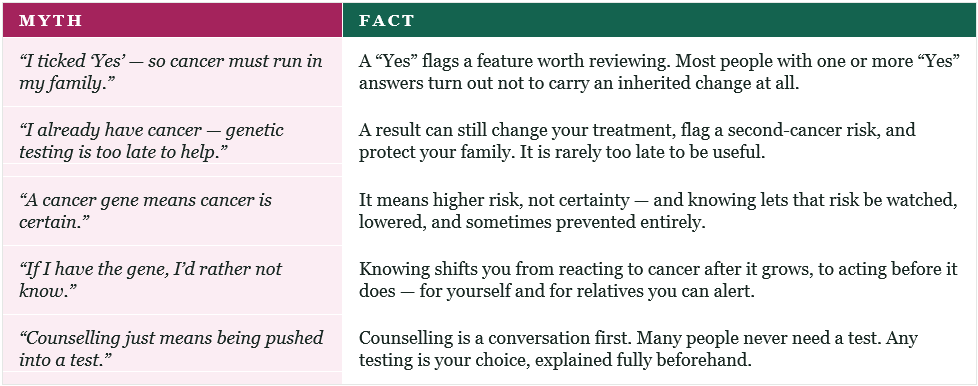
Myth vs Fact
YOUR NEXT STEP
Speak to our Front Office for an appointment with Dr Ravneet Kaur
If you marked one or more “Yes” answers, ask the Fortis Cancer Institute Front Office to schedule a consultation with the Medical Genetics & Precision Oncology team. Bring your completed checklist — it makes the conversation faster and more useful.
Call 72728 72728
Fortis Cancer Institute, Mohali · Department of Medical Genetics & Precision Oncology
Categories
Clear allMeet the doctor

- Medical Genetics | Medical Genetics
- Paediatrics | Paediatrics
-
 9 Years
-
 1500
1500
Related Blogs
View all
Unraveling the power of genes: A lot more than how you look

Breakthrough Discoveries in Genetic Research: Unlocking the Secrets of DNA and Heredity

CHIP Mutations in Hematology: The Silent Forecasters of Risk

Genomics in Hematology: Redefining Diagnosis and Therapy at Fortis Institute of Genomic Me...
Decoding the Mystery of Rare Diseases: A Family’s Guide to Medical Genetics
FAQs
Does one “Yes” answer mean cancer runs in my family?
No. A “Yes” identifies a feature worth reviewing. A full assessment may show the pattern occurred by chance, reflects non-genetic factors, or does warrant genetic testing. Most people with one or more “Yes” answers do not have an inherited mutation.
If I answered “No” to everything, am I in the clear?
It is reassuring, but the checklist is not a complete risk assessment, and “No” does not make risk zero. Keep up routine age-appropriate screening, and revisit the questions if a relative is newly diagnosed or later has a positive genetic test.
Can a harmful gene change come from my father’s side?
Yes. Cancer-related gene changes can be inherited through either biological parent, which is why both maternal and paternal family histories matter — including cancers in fathers, uncles, and grandfathers.
I already have cancer. What’s the point of testing now?
Three points, and any one can matter: a result may open specific treatment options, it flags your risk of a second cancer, and it lets your blood relatives learn whether they share the risk — often the biggest reason patients choose to test.
Can genetic testing guide treatment for someone who already has cancer?
In some situations, yes. An inherited result can influence treatment or future screening — for example, BRCA-related cancers responding to PARP inhibitors, or Lynch-type tumours to immunotherapy. Note that testing your inherited genes and testing the tumour itself are different things, and are not interchangeable.
What is the test — blood or saliva? Is it painful?
Usually a simple blood sample, sometimes saliva — no different from any routine test. It looks at your inherited genes, not the tumour (tumour testing is sometimes done separately to guide treatment).
Can I just order a direct-to-consumer test instead?
Home tests exist, but they are not a substitute for clinical counselling. They can miss important variants, misinterpret risk, or leave you with results you do not fully understand. A counsellor makes sure the right test is ordered and the result is read in proper medical context.
Should my relatives be tested too?
If a specific gene change is confirmed in the family, relatives can be offered focused testing for that exact change — usually simpler and less expensive than the first broad test. Your counsellor will guide how to share the information sensitively.
Will this affect my children — and should they be tested?
Each child of a carrier has about a 50% chance of inheriting the change. Testing of children is generally deferred until adulthood (around 18–25), unless the specific syndrome affects children earlier.
Is my genetic information kept private?
Yes. Your answers, counselling and any results are treated as confidential medical information used to guide your care. You control whom you share results with, and you can raise any specific privacy concern with the counsellor.
Who is Dr Ravneet Kaur, and who will I see?
Dr Ravneet Kaur holds a DM in Medical Genetics from AIIMS and is Consultant in Medical Genetics at the Fortis Cancer Institute, Mohali, in the Department of Medical Genetics & Precision Oncology. She leads hereditary-cancer risk assessment, counselling and cascade testing for patients and families.

Keep track of your appointments, get updates & more!

