
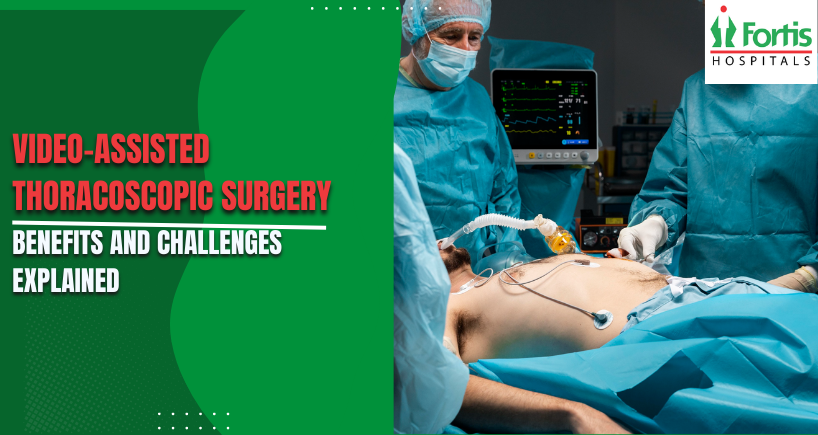


Video-Assisted Thoracoscopic Surgery: Benefits and Challenges Explained
The words "thoracic surgery" have long carried a heavy weight. For decades, any operation in the chest, whether for the lungs or other organs, meant a thoracotomy, a large, intimidating incision. This procedure involves spreading the ribs apart to gain access, a necessary but physically demanding process that results in a long, painful, and complicated recovery. But for many patients today, this daunting image is no longer the reality. A revolution in surgical technique has changed the entire experience, offering a path to healing that is dramatically less invasive.
This modern approach is called Video-Assisted Thoracoscopic Surgery, or VATS. It is a technique that has transformed the field of thoracic surgery, replacing a large incision with a few small ones. This VATS surgery approach is not just about a smaller scar. It represents a fundamental shift in the patient's entire surgical journey, marked by less pain, a shorter hospital stay, and a much faster return to normal life. Understanding the benefits and challenges of this procedure is a crucial first step for any patient facing surgery on the chest.
What Is Video Assisted Thoracoscopic Surgery?
Video-Assisted Thoracoscopic Surgery is a minimally invasive surgical technique used to operate on the chest. Instead of a single, 6-to-10-inch incision and the forceful spreading of the ribs, the surgeon makes two or three small incisions, often no larger than a keyhole.
Through one of these incisions, the surgeon inserts a thoracoscope. This is a tiny, high-definition video camera at the end of a long, thin tube. This camera becomes the surgeon's eyes, projecting a magnified, brilliantly illuminated view of the inside of the chest onto video monitors in the operating room. Through the other small incisions, the surgeon inserts long, highly specialized surgical instruments. By watching the monitor, the surgeon can perform complex procedures with remarkable precision.
This technique, also known as thoracoscopy, allows the surgeon to work between the ribs, not by spreading them apart. This avoidance of a large muscle-cutting incision and rib-spreading is the single most important difference, and it is the source of the procedure's greatest benefits.
Common Applications of the VATS Procedure
The VATS procedure is a versatile and powerful tool. While it cannot be used for every case, it has become the standard of care for a wide variety of conditions affecting the lungs and the space around them.
Lung Cancer Diagnosis and Staging: It is an invaluable tool for performing a biopsy on a suspicious lung nodule or on the lymph nodes in the center of the chest to accurately stage a cancer.
Lung Cancer Treatment: In cases of early-stage lung cancer, VATS can be used to perform the definitive cancer operation, such as a wedge resection (removing a small piece of the lung) or a lobectomy (removing an entire lobe of the lung).
Treating a Collapsed Lung: For patients who suffer from a recurrent collapsed lung (pneumothorax), a VATS procedure can be used to repair the source of the air leak.
Managing Pleural Diseases: The pleura is the thin lining that surrounds the lungs. VATS is very effective for draining a large or persistent fluid collection (pleural effusion) and can be used to perform a pleurodesis, a procedure that helps prevent the fluid from coming back.
Removing Benign Tumors: It is also used to remove non-cancerous tumors from the lungs or the chest wall.
The Major Benefits of VATS Surgery
For the patient, the advantages of a VATS approach over a traditional thoracotomy are profound and impact every phase of recovery.
Significantly Less Post-Operative Pain
This is the most immediate and life-changing benefit. The intense, long-lasting pain of a thoracotomy comes from the large muscle incision and, more so, from the spreading of the ribs, which can stretch or damage the nerves that run beneath them. Because VATS surgery avoids this, the level of post-operative pain is dramatically lower. This means a more comfortable experience and a much-reduced need for heavy narcotic pain medications.
Shorter Hospital Stay
Less pain has a direct ripple effect. Patients who are more comfortable are able to get out of bed, sit in a chair, and walk sooner. They can cough and take deep breaths more effectively, which is critical for clearing the lungs and preventing pneumonia. This entire process accelerates healing, allowing most VATS patients to go home in just two to three days, compared to the seven to ten-day stay often required after open surgery.
Faster Recovery and Return to Life
The recovery at home is also much quicker. The weeks or even months of draining fatigue and pain from a large chest wound are replaced by a recovery that is typically measured in just two to four weeks. Patients are able to return to work, driving, and their normal daily routines much faster.
Reduced Risk of Complications
The smaller incisions and reduced trauma to the body lead to a lower risk of several major complications. This includes a lower chance of surgical site infections, less blood loss during the operation, and a lower incidence of post-operative pneumonia because patients can breathe more deeply and effectively.
The Challenges and Limitations of VATS
While VATS is a remarkable advance, it is important to have a balanced, trustworthy perspective. It is not the right choice for every patient or every situation.
Not All Cases Are Suitable
A traditional open thoracotomy is still the safest and most effective approach in certain complex situations. This includes very large tumors (often over 6-7 cm), tumors that are located in the center of the chest and are close to major blood vessels, or cases with extensive scar tissue from previous infections or surgeries.
A Technically Demanding Procedure
The VATS procedure is a sophisticated technique that requires a great deal of specialized training and experience. The surgeon is operating with long instruments and viewing their movements on a 2D screen, which removes the sense of touch and depth perception. It is critical to seek a surgeon who has performed a high volume of these specific operations.
The Risk of Conversion
In some cases, a surgeon may begin a procedure using VATS but make the safety-first decision to "convert" to an open thoracotomy during the operation. This is not a failure or a complication. It is a judgment call made to protect the patient. This can happen if there is unexpected bleeding that is difficult to control with the VATS instruments or if the anatomy is more complex than pre-operative scans suggested.
A Clearer Path to Thoracic Recovery
Video-Assisted Thoracoscopic Surgery has fundamentally changed the patient experience for the better. It represents a major leap forward, turning a once-dreaded operation into a procedure with a faster, less painful, and more predictable recovery.
By offering a minimally invasive path to treat serious conditions, VATS empowers patients to focus on healing, not just on enduring pain. A detailed discussion with a specialized thoracic surgeon is the best way to determine if this advanced, less invasive approach is the right and safest option for you.
Frequently Asked Questions
Q1. How long does a VATS procedure take?
Ans. The duration depends entirely on what is being done. A simple biopsy may take 30-45 minutes, while a complex lung cancer operation like a lobectomy can take two to three hours. Your surgeon can give you a more accurate estimate for your specific case.
Q2. Is VATS surgery considered major surgery?
Ans. Yes, absolutely. Any operation on the lungs or inside the chest is considered a major surgical procedure. VATS is simply a minimally invasive way to perform that major operation, which results in a much easier recovery for the patient.
Q3. What is the recovery from VATS surgery really like?
Ans. Recovery is much faster than open surgery, but it is still a recovery. You will have a chest tube in place for a day or two to drain fluid and air. You will be sore at the small incision sites, but this is well-managed with medication. Most patients are up and walking the day after surgery and feel progressively stronger over the next few weeks.
Q4. What is the difference between VATS and robotic thoracic surgery?
Ans. Both are minimally invasive approaches to thoracic surgery. In a VATS procedure, the surgeon stands at the bedside and uses their hands to directly manipulate the long, straight instruments. In robotic surgery, the surgeon sits at a console and controls robotic arms that hold wristed, articulating instruments, offering 3D vision. Both are excellent techniques, and the best choice often depends on the specific procedure and the surgeon's expertise.
Categories
Clear allRelated Blogs
View all

Deep Vein Thrombosis (DVT): Causes, Symptoms, and Prevention Tips
Inferior Vena Cava Procedures: What Patients Should Expect Before and After
Understanding Varicose Veins: Causes, Symptoms & Treatment Options
Diabetic Foot Infections: Why Early Care Can Save Your Limb

Sclerotherapy for Varicose Veins: How the Treatment Improves Blood Flow




Keep track of your appointments, get updates & more!

