


Rare Pre-Cancerous Uterine Condition Treated via Advanced Robotic Hysterectomy in a 61-Year-Old Woman at Fortis Noida
The condition occurs in 133 out of 100,000 women and the prevalence in post-menopausal women is 15%-
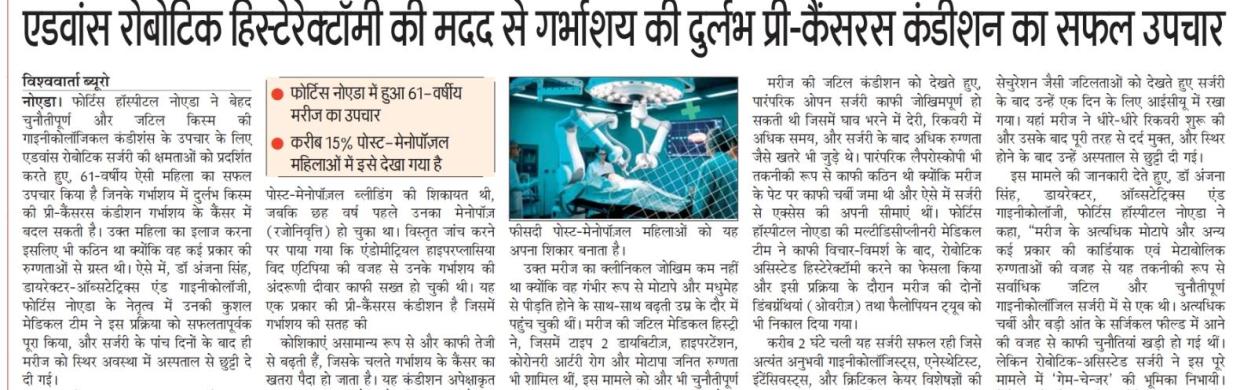
Noida, 27th May 2026: Demonstrating the capabilities of advanced robotic surgery in treating highly complex gynaecological conditions, Fortis Hospital Noida successfully performed a high-risk robotic hysterectomy on a 61-year-old morbidly obese woman with multiple co-morbidities, preventing the progression of a rare pre-cancerous uterine condition into uterine cancer. The complex robot-assisted procedure was led by Dr Anjana Singh, Director- Obstetrics & Gynaecology, Fortis Noida along with her team. Despite the patient’s multiple underlying health challenges, the surgery was completed successfully, and she was discharged in a stable condition within five days.
The patient, weighing 115 kgs with a BMI of 45, had been experiencing persistent post-menopausal bleeding for nearly a year, despite having attained menopause six years earlier. Medical evaluation revealed significant thickening of the uterine lining caused by Endometrial Hyperplasia with atypia , a rare pre-cancerous condition marked by abnormal and rapid growth of cells in the uterine lining, substantially increasing the risk of uterine cancer. The condition is relatively uncommon, with an incidence of approximately 133 cases per 100,000 women, and is seen in nearly 15% of post-menopausal women.
Her risk was further compounded by multiple underlying factors, including severe obesity, diabetes, and advanced age. The case posed significant clinical challenges owing to her complex medical history, as she was already battling Type 2 Diabetes, hypertension, coronary artery disease, and morbid obesity, all of which considerably increased the surgical and anesthetic risks associated with the procedure. Given the complexity of her condition, traditional open surgery posed significant risks including wound complications, prolonged recovery, and increased surgical morbidity. Conventional laparoscopy was also technically difficult because of excessive belly fat and restricted surgical access. After extensive evaluation, the multidisciplinary team at Fortis Hospital Noida decided to proceed with robotic-assisted hysterectomy along with removal of both ovaries and fallopian tubes.
The 2-hour-long surgery was successfully completed by a highly experienced multidisciplinary team comprising gynaecologists, anaesthetists, intensivists, cardiologists, and critical care specialists. Given her high-risk cardiac profile and post-operative oxygen saturation concerns related to obesity, the patient was closely monitored in the ICU for a day after surgery. She showed steady recovery and was discharged pain-free, and in a stable condition.
Giving details of the case, Dr Anjana Singh, Director, Obstetrics & Gynaecology, Fortis Hospital Noida said, “This was one of the most technically challenging gynaecological surgeries due to the patient’s morbid obesity and multiple cardiac and metabolic comorbidities. The excessive visceral fat and bowel intrusion into the surgical field made access extremely difficult. Robotic-assisted surgery proved to be a game changer in this case. The robotic arms allowed us to navigate the difficult anatomy with remarkable precision, minimize blood loss, and complete the surgery safely within two hours. Without robotic technology, managing such a complex case would have been significantly more difficult and risk-prone.”
Mr. Mohit Singh, Zonal Director, Fortis Hospital Noida said, “The successful outcome underscores the transformative role of robotic-assisted surgery in managing high-risk and complex gynecological cases with enhanced precision, reduced blood loss, minimal complications, and faster recovery. It also reinforces Fortis Hospital Noida’s clinical excellence and expertise in delivering advanced, multidisciplinary care through cutting-edge robotic technology.”

Keep track of your appointments, get updates & more!

